

What embryo grading explained means in IVF
Embryo grading explained helps you understand what AA, BB or 3BB actually mean on your IVF report.
These grades describe how the embryo looked in the laboratory — not whether pregnancy will establish after transfer.
Embryo grading is not a single universal system.
Different clinics use slightly different grading frameworks, but most are variations of the same underlying method for assessing blastocyst development.
The most commonly used system is the Gardner blastocyst grading system.
In this system, grading is made up of three parts:
The number (1–6) refers to the degree of blastocyst expansion.
This describes how far the embryo has developed at the time it is assessed.
1–2 → early blastocyst (limited expansion)
3 → full blastocyst
4 → expanded blastocyst
5 → hatching blastocyst
6 → fully hatched blastocyst
Higher numbers indicate more advanced development at that moment in time.
The first letter (A–C) refers to the inner cell mass (ICM).
This group of cells later forms the fetus.
A → tightly packed, clearly defined cells
B → looser grouping, moderate organisation
C → fewer cells, less defined structure
The second letter (A–C) refers to the trophectoderm (TE).
These outer cells contribute to the placenta and are involved in implantation.
A → many cells forming a cohesive layer
B → fewer cells, less organised
C → sparse or irregular distribution
A grading such as 4AA therefore describes an expanded blastocyst with strong fetal and placental cell organisation.
A 3BB indicates a slightly earlier stage with moderate cellular structure.
A 5BC reflects a more advanced stage of expansion but with less cohesive cellular appearance.
Some clinics simplify this system into “good / fair / poor” categories or group embryos into top / average / low quality.
Others may report only the expansion stage or use modified lettering systems.
Day-3 embryo grading: cell number, symmetry and fragmentation
In earlier-stage embryos (commonly assessed around day 3), grading focuses on how the embryo is dividing.
Cell number reflects how many cells are present at that stage.
Embryos that are dividing in a coordinated way typically reach a predictable cell number by day 3, while slower or faster division can indicate variation in developmental timing.
Symmetry of division refers to how evenly those cells are sized.
When cells are of similar size, this suggests coordinated early development. Greater variation in cell size can indicate that division has occurred less synchronously at that stage.
Fragmentation describes small fragments of cellular material that appear between the cells.
These fragments are not functioning cells and are thought to result from uneven division or cellular stress during early development.
Lower levels of fragmentation are generally associated with more organised development, while higher levels may reflect reduced cellular cohesion at that point in time.
Fragmentation is usually described as a percentage of the embryo’s overall structure.
These features are considered together to give an overall impression of how early development is progressing, rather than being interpreted in isolation.
These may be described based on:
• number of cells
• symmetry of division
• degree of fragmentation
For example, an 8-cell embryo with minimal fragmentation is typically considered to be developing in a coordinated way at that stage.
Although the terminology can vary, all grading systems are attempting to describe the same thing:
how the embryo looks at a specific point in development.
What embryo grading is designed to estimate
Embryo grading describes appearance in the laboratory. Implantation determines what happens next.
Embryo grading is therefore a visual classification system, not a functional test.
It does not measure implantation directly or determine whether pregnancy will establish after transfer.
It provides a structured way to compare developmental appearance within a given cohort of embryos.
Understanding the grading language allows you to interpret your clinic report more clearly, particularly when multiple embryos are available and selection decisions are being made.
Why embryo grading cannot predict implantation with certainty
Although embryo grading describes how development appeared in the laboratory, the biological processes through which pregnancy begins to establish are part of the wider physiology of embryo implantation.
Implantation has 5 distinct phases
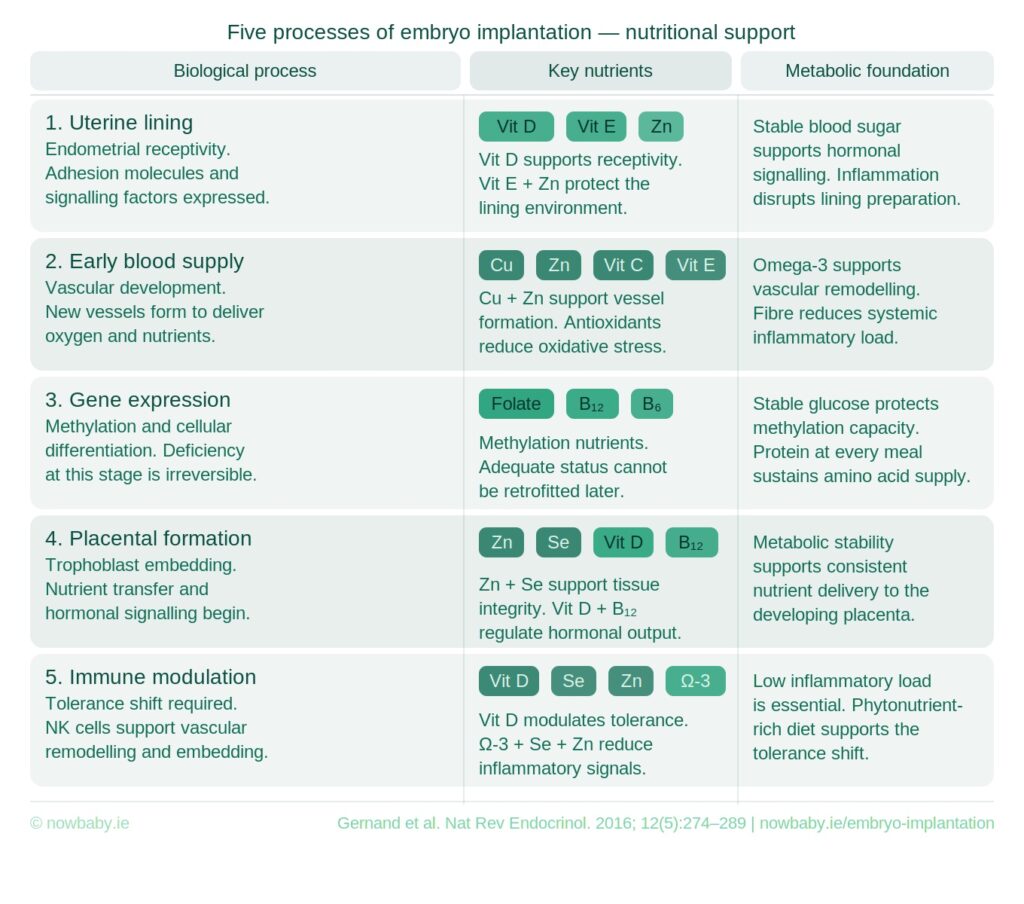
Each phase must complete successfully for pregnancy to progress. The process is dependent on metabolic stability and nutrient availability which can be supported with targeted nutrition. Your clinic has done everything meticulously up to this point, now you can continue supporting your embryo to progress.
The Now Baby FET Implantation Meal Plan is professionally created to support both metabolic stability and targeted nutrient availability during the critical two week wait.