
By the time embryo transfer is being planned, your body is already shaping the conditions your embryo will meet.
Transfer timing determines when your embryo is placed into your uterus.
Your body determines what happens next.
It is not simply a choice between fresh or frozen.
The important factor is what state your body is in when your embryo begins connecting with you.
How fresh and frozen transfer create different implantation starting points
Fresh transfer places the embryo into your uterus during the same cycle as egg retrieval, while your body is still recovering from stimulation.
Your hormone levels are still elevated.
Your body is still settling after the procedure.
Blood flow and immune activity have not fully settled at that point.
Your embryo begins connecting to you within that environment.
This means implantation is starting while your body is still adjusting.
Frozen transfer separates embryo transfer from the stimulation cycle, giving your body time to recover before implantation begins.
Hormone levels have time to settle.
Your uterus can be prepared more precisely.
Your body is in a more stable state at the point your embryo is transferred.
This creates a more controlled starting point for implantation.
How your body’s state affects implantation
Implantation is not automatic once an embryo is transferred.
It begins in the days that follow, as your embryo starts to attach and take hold within your uterus.
This is where the process that leads to your positive pregnancy test begins.
If your body is still fluctuating after stimulation, the process of implantation begins while your system is not yet fully settled.
If your body has stabilised, it begins within a more prepared environment.
This is where implantation either begins to build or struggles to establish.
You have already done everything required to reach this point.
What happens next is how implantation builds over the days that follow.
This period is often described as the two-week wait.
But it is not a passive phase.
It is when implantation is actively building towards your positive pregnancy test.
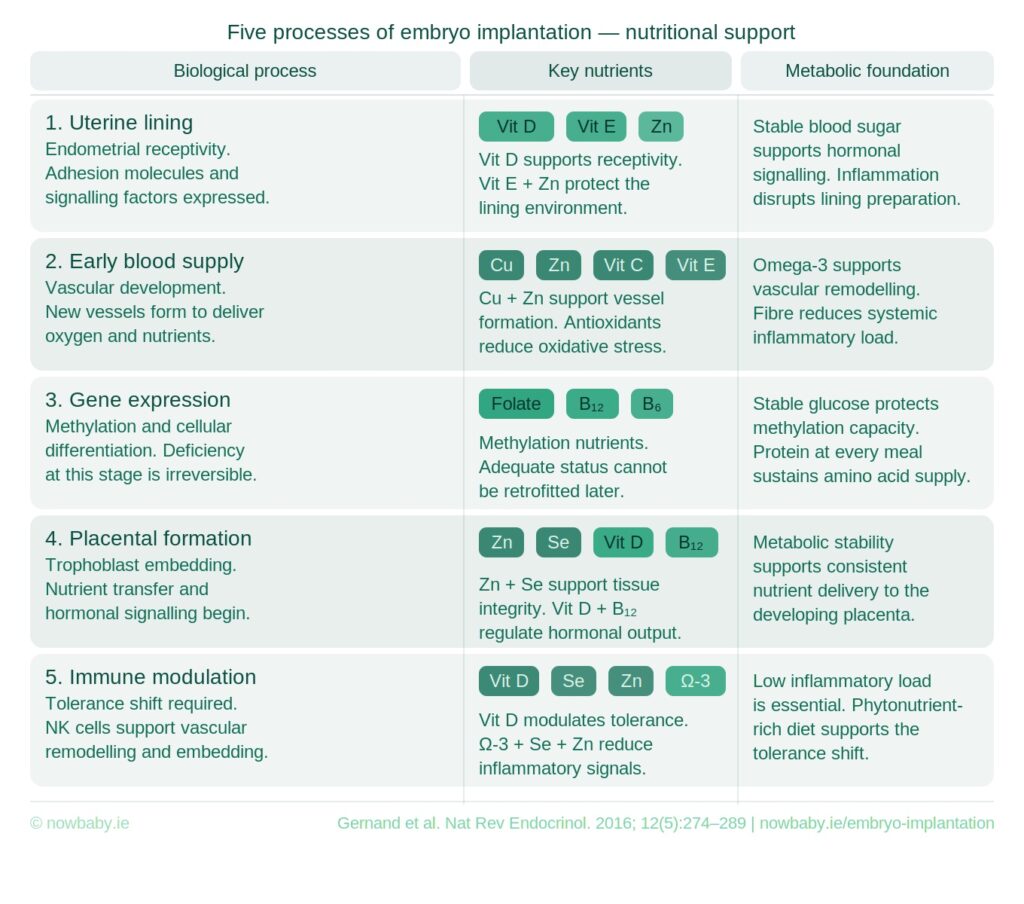
Implantation builds across 5 distinct phases within your uterus over the days that follow transfer, from initial attachment through early blood supply, placenta development and immune adaptation. Each phase must complete successfully for pregnancy to continue.
The distinct phases place different nutritional demands on your body as implantation continues to establish.
Implantation is supported by the right nutrients at the right time.
The Now Baby Implantation Meal Plan keeps your nutrition and metabolic stability consistent throughout the two-week wait, so implantation is supported each day as it builds towards your positive test.

Progesterone support will form part of your transfer protocol.
It prepares your uterus so implantation can begin.
Once transfer has taken place, implantation continues over the following days as early pregnancy starts to establish.
Your body is actively responding throughout this time.
Progesterone remains part of that process.
Implantation continues beyond it.
When fresh transfer remains appropriate
Fresh transfer can work well when your body has responded in a controlled way to stimulation and has settled quickly after retrieval.
Hormone levels are not excessively elevated.
Recovery is smooth.
Your body is already in a stable state when transfer takes place.
In this situation, implantation can begin in an environment that is already prepared.
When frozen transfer becomes the better option
Frozen transfer is often used when your body needs more time to recover after stimulation.
Hormone levels may be higher.
Recovery may take longer.
Your system may not yet be fully settled at the time your embryo would otherwise be transferred.
Delaying transfer allows your body to return to a more stable state before implantation begins.
Whether your transfer is fresh or frozen, this is the point where everything comes together.
You have already done everything required to reach this stage.
What matters now is how implantation will build over the days that follow.
Your embryo will begin to take hold within your uterus.
This is where that process will build, step by step, towards your positive pregnancy test.
And how consistently your body is supported during that time will influence how successfully that process builds.