
Advanced maternal age tells you when chromosome abnormality risk rises.
Ovarian ageing helps explain why that risk rises.
Current research shows more about how that risk develops inside the follicle where the egg matures — and why nutrition support before IVF and PGT-A needs to focus on the metabolic conditions involved in egg maturation and chromosome separation.
If you are considering IVF with PGT-A, the concern is usually clear: you want to reduce the chance of transferring an embryo with the wrong number of chromosomes.
PGT-A tests embryos that reach the blastocyst stage. Embryos reported as aneuploid may be discarded before transfer.
A 2025 review in the Journal of Ovarian Research connects egg maturation inside the follicle with follicular metabolism: the energy, antioxidant and nutrient conditions surrounding the egg while chromosome separation is being prepared. The preparation relies on metabolic stability and nutrient availability throughout that process.
This is where nutrition support becomes relevant: supporting the energy production, antioxidant defence, glucose balance, lipid metabolism and amino acid availability involved while the egg is still maturing inside the follicle.
What ovarian ageing actually means
Advanced maternal age counts the number of years you have lived. Ovarian ageing describes the biological changes taking place inside the ovaries across those years.
Think about skin ageing. Two women can be the same age but have very different levels of wrinkling and sun damage. One may have had years of greater UV exposure, air pollution, smoking, poor sleep or nutritional strain. The other may have had less cumulative exposure and stronger protection and repair.
Their birthdays are identical. The biological wear carried by their skin is not.
Ovarian ageing follows the same principle.
As the ovaries age, fewer dormant follicles remain available to enter development. But egg number is only one part of the change. Ovarian ageing also affects the biological environment in which the remaining eggs mature.
Each developing egg is supported by the cells surrounding it inside the follicle. These cells help process glucose and fats, supply amino acids, produce energy and manage oxidative stress while the egg prepares for fertilisation.
The egg must also organise and separate its chromosomes accurately. This requires mitochondrial energy and stable cellular structures capable of moving one copy of each chromosome into the mature egg.
The conditions surrounding that process are influenced by glucose and lipid metabolism, nutrient availability, oxidative stress, inflammation and mitochondrial function. With ovarian ageing, these systems can become less efficient and chromosome separation can become more vulnerable to error.
Maternal age tells you when these changes become more common across a population. It cannot show the cumulative biological strain carried by one woman’s ovaries or the metabolic conditions surrounding the eggs developing in her current IVF cycle.
That is why age identifies when chromosome abnormality risk rises, while ovarian ageing helps explain the biology behind that risk.
Why chromosome abnormality becomes the concern after 35
After 35, the concern becomes more personal: not just whether embryos are created, but whether they have the chromosome number needed before transfer.
This is why PGT-A can feel important. You are looking for more information before deciding which embryo to transfer.
Once chromosome abnormality becomes part of the decision, the number of eggs collected starts to carry more weight.
Why the number of eggs collected matters
The number of eggs collected shapes your starting point. A stronger starting number gives more room for the biological and laboratory attrition that happens before transfer: maturity, fertilisation, blastocyst development and PGT-A.
A 2021 study reported aneuploidy rates by SART age grouping as follows:
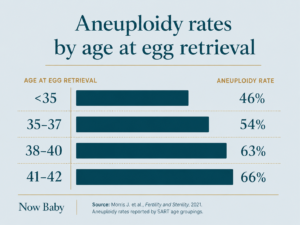
These figures are population-level attrition data. They show why the starting number of eggs becomes more important as maternal age rises. As the proportion of embryos reported as aneuploid increases, each stage of the IVF process carries more pressure: egg collection, fertilisation, blastocyst development, PGT-A reporting and transfer planning.
When egg number is lower, each developing egg carries more weight through the IVF process.
This is especially relevant if you have low AMH, a previous poor response to stimulation, a low number of eggs collected, or repeated cycles where few embryos reached testing.
A higher egg number can create more opportunity through the IVF attrition funnel. Egg quality then helps shape what happens to that opportunity as eggs mature, fertilise, develop and prepare for chromosome separation.
The number of eggs collected shapes the starting point. Egg quality affects the stages between collection and transfer: maturity, fertilisation, embryo development and the chromosome separation needed for a euploid embryo.
Egg quality matters before egg retrieval
The eggs you are developing have been recruited out of dormancy around 90 days before retrieval. That is why egg quality nutrition is not a last-minute task: the preparation window begins while those follicles are developing and the egg is maturing inside the follicle.
During those 3 months, the egg is preparing the chromosomes needed for a euploid embryo — an embryo having the expected number of chromosomes. That process depends on cellular energy, mitochondrial function, antioxidant defence and the metabolic environment inside the follicle. Nutrition helps shape that metabolic environment before collection.
What the 2025 review explains about follicle metabolism
The 2025 review explains that the conditions inside the follicle help shape how the egg develops and how accurately its chromosomes separate. It focuses on how glucose, fats and amino acids are used to support the egg while it matures.
Glucose metabolism helps supply the energy needed by the follicle and maturing egg. Lipid metabolism contributes to energy handling, cell structure and signalling inside the follicle. Amino acid metabolism supports cellular protection and antioxidant defence while the egg is developing.
These pathways matter because the maturing egg is preparing for accurate chromosome separation before fertilisation — one of the key steps involved in creating a euploid embryo.
Why follicle metabolism matters before fertilisation
Blood tests can be helpful, but they can miss the daily pattern the follicle is exposed to. HbA1c gives an average picture of blood glucose over time; it does not show the effect of skipping breakfast, using coffee instead of food, delaying protein until later in the day, or swinging between long gaps and quick sugar fixes.
These patterns matter because follicle metabolism responds to real-time shifts in energy availability, glucose balance and stress chemistry. A steadier daily rhythm gives the body a more consistent metabolic signal during the preparation window before IVF.
This is where nutrition support becomes practical. Before fertilisation, the focus is not a single nutrient or supplement. It is the daily structure that supports steadier energy, protein timing, blood sugar balance and the metabolic conditions involved in egg quality.
Why egg quality nutrition needs a structure
When you are preparing for IVF with PGT-A, it is easy to focus on the individual pieces you can see: supplements, blood-test results, specific nutrients, meal timing and blood sugar balance.
But egg maturation does not depend on one isolated input.
Energy production, glucose metabolism, lipid handling, amino acid availability and antioxidant defence are connected inside the developing follicle. Supporting one area while overlooking the wider daily pattern can leave important gaps during the months before egg retrieval.
That is why egg quality nutrition needs structure rather than a collection of last-minute changes.
Preparing before IVF and PGT-A
PGT-A provides information about the chromosome number of embryos that reach the blastocyst stage. It cannot influence the biological processes that took place while the egg was developing.
That work happens earlier.
The follicles recruited for an IVF cycle have been developing for approximately 3 months before egg retrieval. During that time, the egg is maturing, producing energy and preparing for the chromosome separation needed before fertilization.
This is the preparation window nutrition can support.
The aim is to create a more consistent daily metabolic environment through regular meals, adequate protein, balanced carbohydrate intake, appropriate fats and the micronutrients involved in cellular energy production and antioxidant defence.
Advanced maternal age identifies when chromosome abnormality becomes more likely. Ovarian ageing and follicular metabolism help explain how that risk develops.
A higher egg number gives more opportunity through maturity, fertilisation, blastocyst development and PGT-A. When fewer eggs are retrieved, there is less room for attrition and each developing egg carries more weight through the IVF process.
That is why the significance of egg number begins before collection: the fewer eggs expected, the more important the metabolic conditions surrounding each one while it matures.