
When you are preparing for an embryo transfer, a success rate does not feel like a statistic. It feels personal. Even more so when this may be your last embryo.
Across embryo transfers overall, approximately two in three do not result in a live birth. That does not mean your embryo has a fixed one-in-three chance. The overall figure combines embryos created at different ages, tested and untested embryos, different embryo stages and grades, and transfers reported using different measures of success.
Understanding which embryos were counted and whether “success” means a positive test, clinical pregnancy or live birth allows you to find the figure closest to the transfer you are preparing for.
Embryo Transfer Success Rates at a Glance
Across embryo transfers overall, approximately one in three results in a live birth. The remaining two in three include transfers that do not implant, pregnancies that stop developing before an ultrasound scan and clinical pregnancies that end before birth.
That overall figure is not the success rate of every embryo. The probability attached to an individual transfer changes according to:
- whether the embryo was PGT-A tested
- the age of the woman when the egg was collected
- whether a day-three embryo or blastocyst is transferred
- embryo development and grading
- whether the reported outcome is a positive test, clinical pregnancy or live birth
A euploid embryo has already passed through chromosome screening before reaching transfer. An untested embryo may be euploid or aneuploid, and that uncertainty remains within its published transfer rate.
This is why two clinics can publish very different percentages without either figure necessarily describing the embryo you have available. The numerator matters, but so does who—and which embryos—were included in the denominator.
Clinical Pregnancy Versus Live Birth After Embryo Transfer
A clinical pregnancy is usually recorded when an ultrasound scan confirms a gestational sac. It comes after a positive pregnancy test, but before the pregnancy outcome is known.
A live birth rate measures how many embryo transfers ultimately result in the birth of a living baby. It is therefore lower than the clinical pregnancy rate because some pregnancies end after ultrasound confirmation.
An ongoing pregnancy rate may also be reported, often after a specified number of weeks. This moves closer to live birth than a clinical pregnancy rate, but it is still not the same outcome.
When comparing embryo transfer success rates, check both the endpoint and the denominator. A 50% clinical pregnancy rate per transfer cannot be compared directly with a 35% live birth rate per treatment cycle.
Embryo Transfer Success Rates by Age
The age that matters most is your age when the egg was collected, not your age on the day the embryo is transferred.
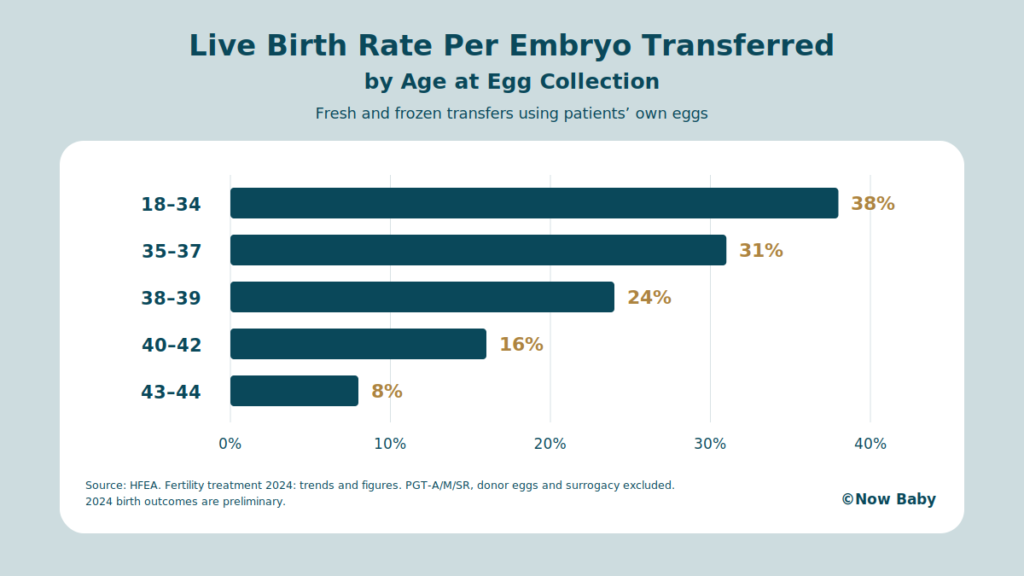
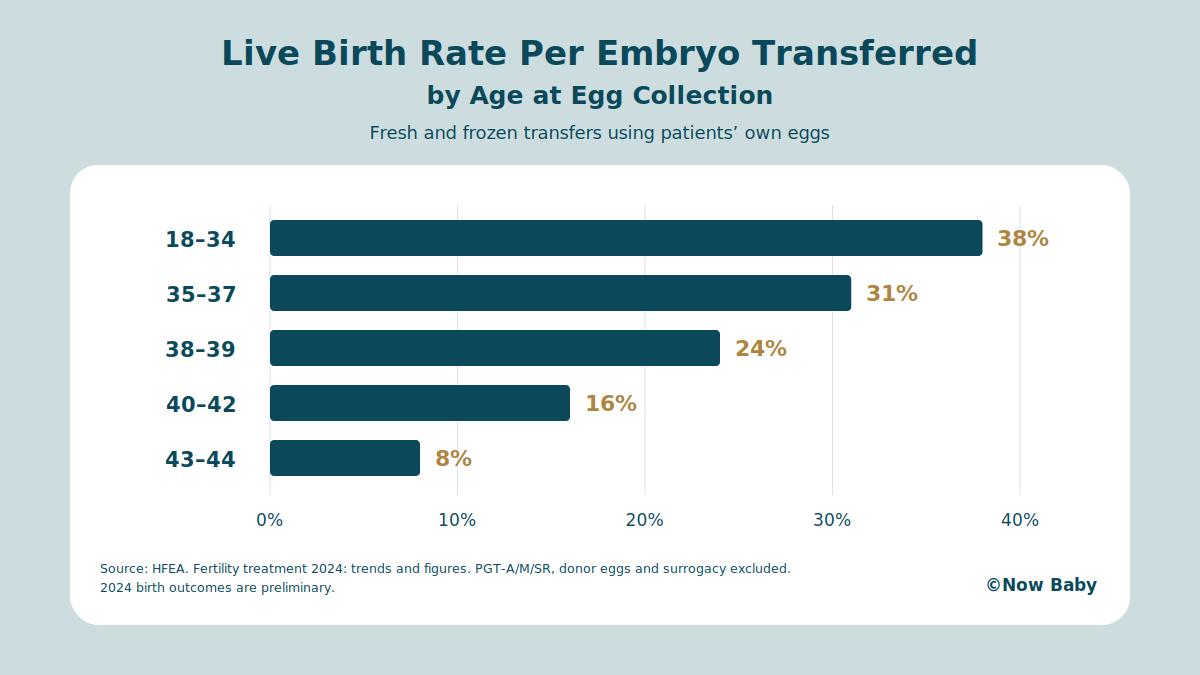
The difference largely reflects the increasing proportion of embryos with chromosome abnormalities as egg age rises. An untested embryo created at 42 therefore carries a different probability from an untested embryo created at 32, even if both are transferred at the same age.
If your embryo has been confirmed as euploid through PGT-A, these general age-based rates do not describe your transfer accurately because the largest age-related risk has already been screened before transfer.
How Embryo Stage Affects Transfer Success Rates
Blastocyst transfers generally have higher success rates per embryo transferred than day-three embryo transfers. By day five or six, the embryo has continued developing in the laboratory, allowing the clinic to see which embryos reached the blastocyst stage.
This creates another selection point. Embryos that stopped developing before blastocyst are not included in the blastocyst transfer rate.
A day-three embryo has had less time to demonstrate its developmental potential before transfer. Its lower average success rate does not mean transferring it caused the outcome; more of the uncertainty remains at the point it enters the uterus.
Among blastocysts, day of development and embryo grade provide further context. They can help rank embryos for transfer, but they cannot determine whether an individual embryo will result in a live birth.
Fresh Versus Frozen Embryo Transfer Success Rates
This does not mean freezing an embryo makes it more likely to result in a live birth. Embryos frozen for later transfer have usually reached a stage and quality suitable for storage, so this group has already passed through additional selection.
Fresh and frozen transfers also involve different treatment populations and cycle conditions. The published rates cannot isolate freezing as the reason for the difference. For a woman already preparing for FET, the frozen transfer rate is the more relevant starting point.
How PGT-A Changes Embryo Transfer Success Rates
PGT-A changes the group of embryos that reaches transfer. Embryos reported as aneuploid are usually excluded, while embryos reported as euploid are prioritised.
The published success rate for a euploid embryo transfer is therefore calculated after the embryos with the highest chromosome-related risk of implantation failure or pregnancy loss have been removed. This is why euploid embryo transfers have higher average success rates than transfers of untested embryos.
PGT-A did not make the transferred embryo more capable of producing a live birth. It provided information that allowed embryo selection before transfer.
If your embryo is confirmed as euploid, euploid transfer data are more relevant than general rates based on your age at egg collection. If your embryo is untested, age remains important because its chromosome status is still unknown.
Per-Transfer Success Is Not the Same as Success Per Egg Collection
A success rate per embryo transfer begins counting only when an embryo is transferred. It does not include egg collections that produce no blastocyst, no euploid embryo or no embryo suitable for transfer.
This distinction becomes particularly important with PGT-A. If ten women begin an IVF cycle but only six have a euploid embryo to transfer, the per-transfer rate is calculated from those six transfers. The other four cycles are absent from that figure.
If you already have a euploid embryo in storage, the per-transfer rate is relevant to the position you are now in. If you are deciding whether to begin another egg collection, the live birth rate per egg collection provides a more complete measure of the path ahead.
Why Published Success Rates Cannot Predict Your Individual Transfer
A success rate describes what happened across a group of embryo transfers. It cannot identify in advance which individual embryos will result in a live birth.
Your most relevant estimate comes from the group that most closely matches your transfer: tested or untested, age at egg collection, embryo stage and grade, and fresh or frozen transfer. Each detail narrows the comparison, but none removes the remaining uncertainty.
A 50% live birth rate does not mean that your embryo is half capable of succeeding. It means that approximately half of comparable transfers resulted in a live birth and half did not.
If this is your last embryo, a group average can feel brutally inadequate. But once it has placed your embryo within the closest comparable group, the statistic can tell you nothing more. The outcome now depends on whether this embryo can complete implantation and early pregnancy development within the conditions of this transfer cycle.
What Still Has to Happen After the Embryo Is Transferred
Embryo transfer places the embryo inside the uterus. The outcome still depends on whether implantation begins and continues.
A transfer success rate compresses everything that happens after transfer into a single outcome. There are more milestones yet to come, first beta, first scan, graduation from the IVF clinic. Average success rates cannot show whether an individual embryo will implant or whether the pregnancy will continue.
PGT-A reduces one source of uncertainty before transfer. It cannot predict what will happen once the embryo enters the uterus.
Implantation Has 5 Distinct Phases
Implantation has 5 distinct phases and each has to complete successfully for pregnancy to continue.
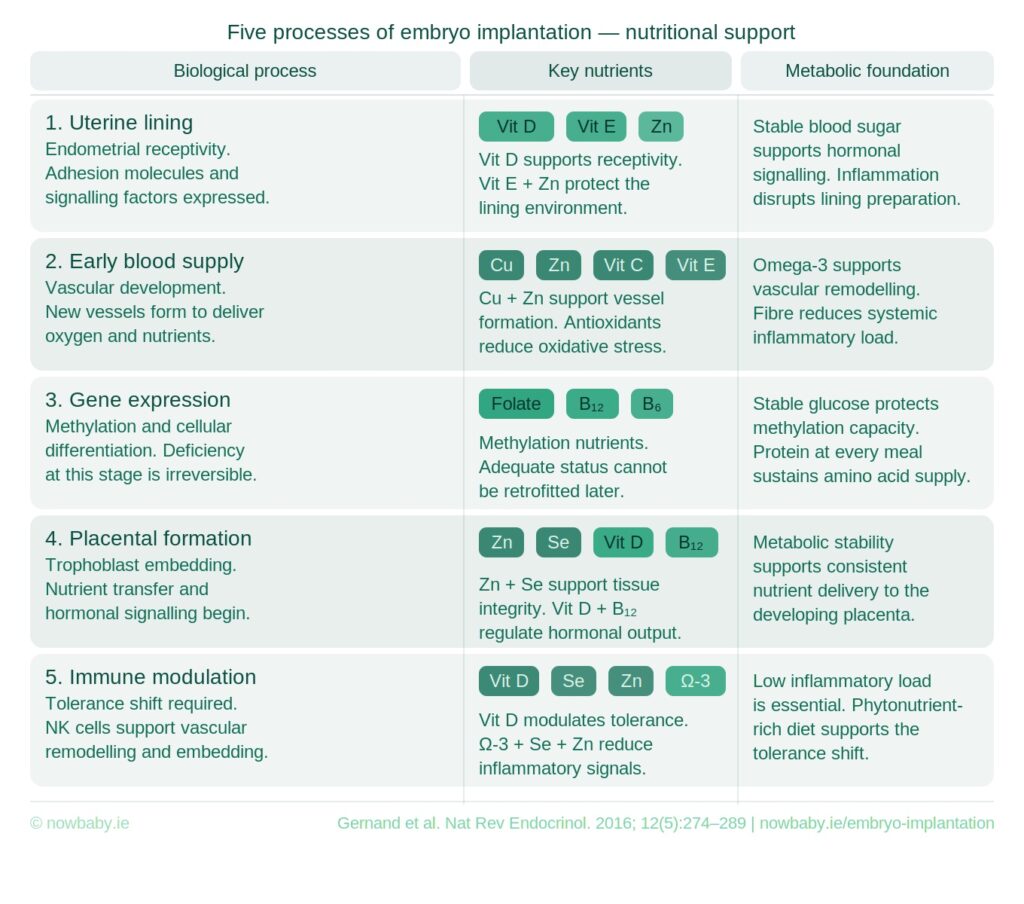
During those stages, cells divide rapidly, genes are regulated, blood vessels begin to develop, the immune system adapts and the earliest placental structures begin to form.
Each of these processes depends on a consistent supply of energy, amino acids, essential fats, vitamins and minerals. Food is how those nutritional raw materials are supplied during the days between transfer and beta.
Your clinic will prepare meticulously for transfer. You can bring that same level of precision to meeting the nutritional demands of your embryo at this critical phase.
The professionally designed Now Baby FET Implantation Support Meal Plan translates the science of the 5-stage implantation process into a structured 14-day food protocol, with every meal designed around the nutritional and metabolic demands between transfer and your beta test.
Get the FET Implantation Support Meal Plan