

As you approach frozen embryo transfer, you will start wondering about the next phase of your progesterone medication. How much longer will you need it, and is there any risk when you stop?
You have relied on progesterone to prepare and maintain your uterine lining, so stopping can feel unsettling even when your transfer has worked and the pregnancy is progressing normally. A positive pregnancy test does not usually mean progesterone ends straight away. It is often continued for several more weeks while the placenta gradually takes over progesterone production, with your clinic setting the stop date for your protocol.
Why progesterone continues after frozen embryo transfer
By the time your embryo is transferred, progesterone has changed your uterine lining from one that is growing into one that can receive the embryo.
After transfer, progesterone continues to maintain that lining while your embryo hatches, makes contact with the endometrium and begins embedding into it.
This is an active biological phase. Cells within the lining continue changing to support embryo communication, immune adaptation and the earliest stages of placental development. The hormonal environment created for your transfer must remain stable while those processes unfold.
A positive pregnancy test confirms that implantation has produced detectable hCG, but the placenta is still developing its capacity to produce the progesterone needed to maintain the pregnancy. Progesterone medication is therefore usually continued beyond the pregnancy test until your clinic reaches the planned stop point in your treatment protocol.
How long progesterone is usually used after FET
You will usually continue progesterone every day until the pregnancy test arranged by your clinic.
A positive result normally means continuing for several more weeks, often until around 8 to 12 weeks of pregnancy. A negative result usually means your clinic will tell you to stop.
When your clinic says progesterone will continue until 8, 10 or 12 weeks, it means 8, 10 or 12 weeks pregnant — not that many weeks after embryo transfer. In IVF, you are already counted as more than two weeks pregnant on the day of transfer, with the exact dating based on the age of the embryo transferred.
Your clinic will give you the exact date to stop progesterone based on its protocol and your treatment history.
Why clinics give different stop dates
Your placenta does not begin producing enough progesterone all at once. Its production builds across the first weeks of pregnancy, which is why clinics use different stop dates rather than one fixed week for everyone.
There is no routine test that identifies the exact day your placenta can maintain the pregnancy without medication. A blood test measures all the progesterone circulating in your body and cannot reliably separate what is coming from your medication from what is being produced by the placenta. Clinics therefore base the stop date mainly on the stage of pregnancy and their own treatment protocol.
One clinic may stop progesterone at 8 weeks while another continues to 10 or 12 weeks. An early ultrasound can also confirm that the pregnancy is in the uterus and developing as expected, including whether a heartbeat is visible at the appropriate stage. The scan does not measure placental progesterone production, but it gives your clinic important information about how the pregnancy is progressing as you approach the planned stop date.
Bleeding in early pregnancy needs its own assessment. Progesterone cannot correct every cause of bleeding, and continuing routine FET progesterone for longer has not been shown to stop bleeding or sustain every pregnancy.
The evidence supports progesterone in one more specific situation. Women who have bleeding in early pregnancy and have previously experienced at least one miscarriage may be offered vaginal micronised progesterone. When a heartbeat is confirmed, this may be continued until 16 completed weeks. The evidence relates to a possible increase in live births within this particular group. It does not show that progesterone stops the bleeding, and it is not a reason to extend progesterone after every frozen embryo transfer.
A previous miscarriage without bleeding in the current pregnancy does not automatically mean that progesterone is needed for longer. Your clinic can consider your pregnancy history alongside your ultrasound findings and how this pregnancy is progressing, while keeping the routine FET timeline separate from progesterone prescribed for threatened miscarriage.
Progesterone after a positive pregnancy test
A positive pregnancy test confirms that implantation has progressed far enough for hCG to be detected. It is still an early result, so your clinic may repeat the hCG blood test to check that the level is rising as expected before arranging an ultrasound at the appropriate stage.
After a positive test, your clinic may move from a single pregnancy result to repeat hCG testing and early ultrasound monitoring. Your progesterone dose, route and planned stop date usually remain unchanged unless those assessments give your clinic a reason to revise the plan.
Over the days that follow, your embryo continues embedding into the uterine lining, maternal blood vessels begin to remodel, immune tolerance develops and the first placental structures form. Progesterone helps maintain the hormonal conditions for this work, but the process itself has broader biological demands that continue beyond the test result. Metabolic stability and specific nutrient availability have been shown to have significant influence at this stage.
Progesterone after a negative test
If your pregnancy test is negative, your clinic will usually tell you to stop progesterone because the medication is no longer required. Once the result shows that no continuing pregnancy signal has been detected, keeping progesterone going cannot change the outcome of the transfer.
Progesterone may have prevented your uterine lining from breaking down before the test, even when implantation has not continued. After the medication is stopped, progesterone levels fall and a withdrawal bleed usually begins within a few days. The timing, flow and cramping may feel different from your usual period.
A low or borderline hCG result is different from a confirmed negative result. Your clinic may repeat the blood test to see whether hCG is rising or falling before changing your medication plan. Progesterone may continue during that assessment until the result is clear.
Bleeding before your scheduled pregnancy test does not provide that answer. Complete the test on the date set by your clinic and contact them promptly if the bleeding is heavy or accompanied by significant pain.
Nutrition support during the implantation window
Your progesterone medication provides hormonal support for the uterine lining. The implantation process unfolding alongside it has five distinct stages: uterine lining receptivity, early blood supply, gene expression and cellular differentiation, placental formation and immune modulation.
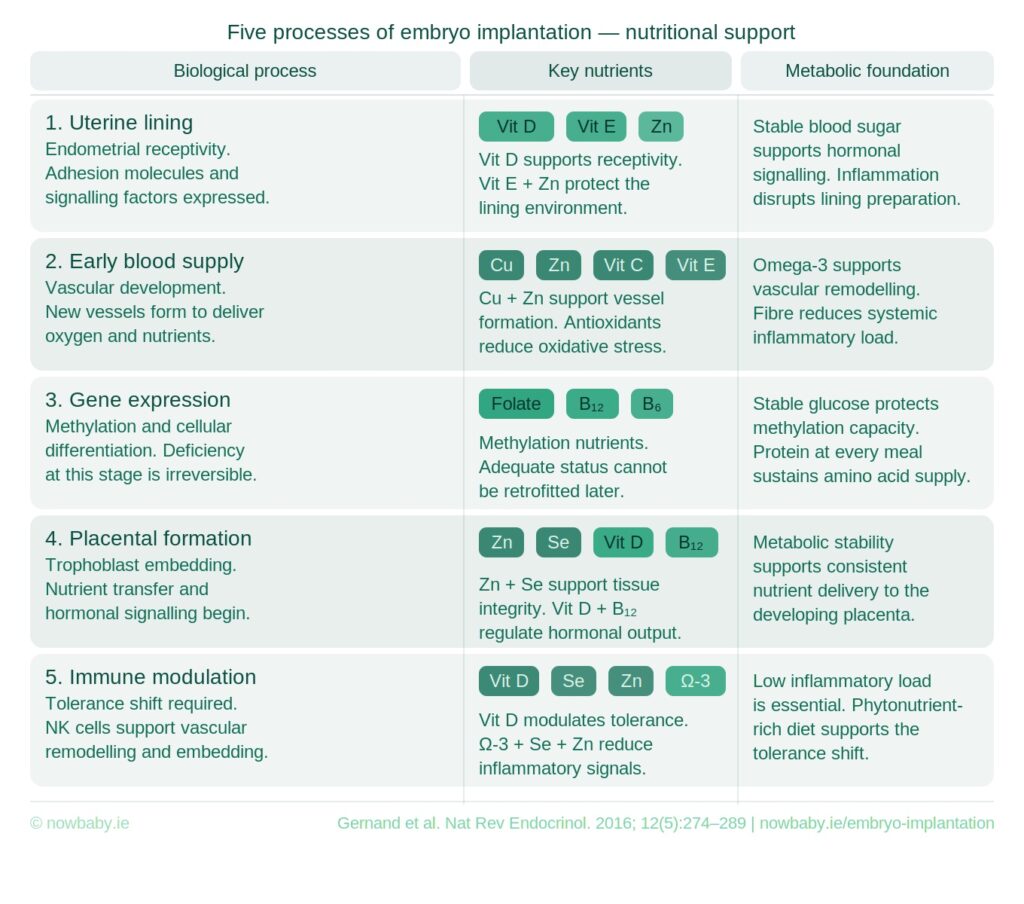
Each stage has its own nutritional and physiological demands. Cells need energy to divide, amino acids to build new tissue, essential fats to form cell membranes and specific micronutrients for blood-vessel development, gene regulation and immune adaptation. Metabolic stability affects how consistently those resources are available while this work continues.
Progesterone cannot complete these five processes. Its specific role is to prepare and maintain the uterine lining.
This is not a task that supplements can deliver either. These processes depend on a consistent supply of energy, protein, fats, vitamins and minerals from food, together with the metabolic stability needed to use them.
Your implantation window beyond progesterone
The implantation window depends on more than progesterone. There are multiple factors unfolding in a short window, the outcome of which decides whether your pregnancy progresses or not. Your clinic is not leaving anything to chance, and you shouldn’t either. The role of specific nutrients is critical to your success, and you have an opportunity to support this intentionally.
At Now Baby, we have taken the guesswork out for you and created a professionally curated FET implantation support meal plan. Each day of the two week wait before your beta test matters and what you eat during that phase matters too.
Get the FET Implantation Support Meal Plan