
When you have a low mosaic embryo, you may need to decide whether to transfer it before or after your other embryos, or whether to consider another egg collection first.
The mosaic level is part of that decision, but it is only one part.
Transfer priority also depends on the chromosome involved, embryo grading, the other embryos available and the realistic prospect of creating more embryos.
What “low mosaic” means on your PGT-A report
A mosaic result means the biopsy contained a mixture of chromosome findings.
Some of the cells tested appeared to have the expected number of chromosomes, while others showed extra or missing chromosome material.
A low mosaic result means the biopsy contained a small amount of abnormal chromosome material, more than would usually be seen in a euploid result but less than in a high mosaic result.
“Low” refers to the estimated proportion of the abnormal finding within the biopsy. The percentage range used to classify a result as low mosaic can vary between laboratories.
How the mosaic level is estimated from a small biopsy sample
The percentage on your report comes from a biopsy of around five to ten cells taken from the outer layer of the blastocyst.
The tiny amount of DNA in those cells is copied and analysed together as one sample. For each chromosome, the laboratory measures how much DNA is present.
When the cells contain the expected two copies of a chromosome, the amount of DNA follows a euploid pattern. An extra copy produces more chromosome material. A missing copy produces less.
A mixture produces a measurement between those patterns. The laboratory uses how far the measurement has shifted from the euploid amount to estimate the proportion of cells in the biopsy carrying the extra or missing chromosome finding.
The percentage is an estimate, not a count of individual cells. A result reported as 30% mosaic does not establish that exactly 30% of the embryo is abnormal. It means the pooled DNA from that small biopsy was consistent with the laboratory’s 30% mosaic range.
The biopsy gives useful information about the cells tested. It cannot provide a cell-by-cell map of the whole embryo.
How a low mosaic embryo compares with an available euploid embryo
When a euploid embryo and a low mosaic embryo are both available, the euploid embryo will usually be transferred first.
In a matched study comparing low mosaic and euploid embryo transfers, 41.7% of low mosaic transfers resulted in a clinical pregnancy, compared with 57.7% of euploid transfers. The live birth rates were 38.3% and 51.4%.
That is roughly four live births for every ten low mosaic embryos transferred, compared with five for every ten euploid embryos in this study.
A low mosaic embryo still carries meaningful reproductive potential. The difference is that an available euploid embryo has the more reassuring PGT-A result and the stronger expected outcome, so it is usually given transfer priority.
The low mosaic embryo can remain available if another transfer is needed.
Comparing a low mosaic embryo with your other mosaic embryos
When more than one mosaic embryo is available, the mosaic level can help determine transfer order.
A low mosaic embryo is often prioritised over a high mosaic embryo because the biopsy contained a smaller proportion of abnormal chromosome material.
In one study, 44.6% of low mosaic transfers resulted in a live birth, compared with 36% of high mosaic transfers. The difference was not statistically significant, but the miscarriage rates were 5.1% and 30.7% respectively.
The high mosaic group was small, so the size of the difference remains uncertain. Even so, the findings help explain why a low mosaic embryo may be placed ahead of a high mosaic embryo when both are available.
When two embryos are both low mosaic, a small difference between their reported percentages should not carry the whole decision. The chromosome finding and embryo grade still contribute to the comparison.
Why the chromosome finding still matters
Two low mosaic embryos with the same reported percentage may carry very different chromosome findings.
One may involve part of a single chromosome, known as a segmental finding. Another may involve an entire chromosome. A third may involve several chromosomes.
In a study of 1,000 mosaic embryo transfers, 43.1% of segmental mosaic transfers resulted in an ongoing pregnancy or birth. The rate was 34.8% when one whole chromosome was involved, 34.4% when two chromosomes were involved and 20.8% for complex findings involving three or more chromosomes.
Those figures show why “low mosaic” cannot carry the whole comparison. How much of the chromosome is affected and how many chromosomes are involved can change transfer priority.
The chromosome number itself does not currently provide a reliable ranking for transfer success. It still matters because some chromosome findings can continue into pregnancy, and the chromosome named on the report affects the genetic counselling and prenatal diagnostic testing discussed if pregnancy follows.
A low mosaic percentage is one part of the result. The full finding tells you what kind of mosaicism was detected and what questions need to be answered before that embryo is placed ahead of another.
What embryo grading contributes to the comparison
Your embryo grade becomes most useful when two embryos have similar PGT-A findings.
The grade records how the blastocyst developed before it was frozen. The number describes how far it had expanded. The first letter describes the group of cells that develops into the baby, and the second describes the outer cells that help form the placenta.
A stronger grade is associated with a greater chance of continued development after transfer. In one study, 57.1% of good-grade mosaic embryos resulted in a live birth, compared with 38.1% of fair or poor-grade mosaic embryos.
The study was small, so the size of that difference remains uncertain. It still shows why grading contributes useful information when the mosaic level and chromosome findings are otherwise similar.
A well-graded low mosaic embryo may therefore be prioritised over a more poorly graded mosaic embryo with a comparable PGT-A result. The grade adds to the chromosome information. It does not replace it.
How maternal age at egg collection affects the chance of other euploid embryos
Maternal age at egg collection is one factor used to estimate how likely the other embryos from that retrieval are to be euploid.
Recent research shows that the follicular environment in which the egg matured also affects whether its chromosomes separate correctly. Maternal age therefore contributes to the estimate, but it does not explain the chromosome result on its own.
For embryos already created, the relevant age is maternal age at egg collection, not your current age.
How current age, low AMH and previous ovarian response affect another retrieval
If you are deciding between transferring your low mosaic embryo and attempting another egg collection, the relevant question is what another retrieval is realistically likely to produce now.
Your current maternal age contributes to the chance that any new embryos will be euploid. AMH helps estimate how many eggs your ovaries may produce in response to stimulation. It does not measure the quality or chromosome status of those eggs.
Your previous IVF cycle shows how your ovaries and embryos actually responded. The number of mature eggs collected, how many fertilised, how many reached blastocyst and the PGT-A results provide more individual context than AMH alone.
A previous cycle that produced several blastocysts may support considering another retrieval, even with low AMH. A low response followed by few or no blastocysts may mean another cycle is less likely to change the embryos available.
These factors establish whether another egg collection offers a realistic alternative to transferring the low mosaic embryo you already have.
When the low mosaic embryo may be your strongest remaining option
A low mosaic embryo may become your strongest remaining option when no euploid embryos are available and another egg collection is unlikely to produce a better embryo.
This is more likely when previous retrievals produced few mature eggs or blastocysts, current AMH suggests a limited response and maternal age reduces the prospect of creating a euploid embryo in another cycle.
The decision is then between the embryo already available and the time, cost and physical demands of another retrieval with an uncertain outcome.
The full PGT-A finding and embryo grade still matter. A low mosaic embryo with a more favourable chromosome finding and stronger grade may offer a more realistic route to transfer than another mosaic embryo or another retrieval with a low expected yield.
Calling it your strongest remaining option does not remove uncertainty. It means that, after the alternatives are compared honestly, this embryo may offer the clearest remaining path to pregnancy.
How future sibling plans affect transfer priority
The number of children you hope to have can affect whether transfer or another egg collection comes first.
If one child is your goal, the decision can focus on the strongest embryo already available.
If you hope for more than one child, another retrieval before transfer may preserve the chance to create embryos for a future sibling. A successful transfer would delay any further egg collection until after pregnancy and recovery, when maternal age may reduce the expected number of euploid embryos created.
This is why a low mosaic embryo may be ready for transfer but still follow another egg collection in the treatment plan.
The decision is not only which embryo offers the strongest option now. It is whether using that embryo now leaves enough opportunity to build the family you hope for.
Questions to ask before choosing which embryo to transfer
Before choosing transfer order, ask your clinic to compare the embryos and treatment options available to you as a whole.
- Do I have a euploid embryo that would usually be transferred first?
- How does this low mosaic embryo compare with my other mosaic embryos?
- Is the finding segmental or does it involve a whole chromosome?
- How many chromosomes are involved, and which chromosome has been identified?
- How does the embryo grade affect its place in the transfer order?
- What did my previous retrieval show about my likely response to another egg collection?
- Given my current maternal age and AMH, is another retrieval likely to change the options available?
- Would delaying transfer for another retrieval better support our plans for future siblings?
- Does the clinic recommend genetic counselling before transfer?
- If the transfer leads to pregnancy, which prenatal diagnostic tests would be discussed?
You should leave that conversation knowing which embryo your clinic recommends transferring first, why it has been prioritised and whether another egg collection should happen before transfer.
The PGT-A result, chromosome finding and embryo grade are already fixed. Once transfer is going ahead, the next concern is whether implantation can progress successfully.
That is where your preparation still matters.
Your Opportunity to Support Implantation
Choosing to transfer a low mosaic embryo can bring relief that there is a way forward and fear that this embryo may have a lower chance of success than a euploid embryo.
When it may be your strongest remaining option, you want to know what can still be done to support implantation
Implantation has 5 distinct phases and each has to complete successfully for pregnancy to continue.
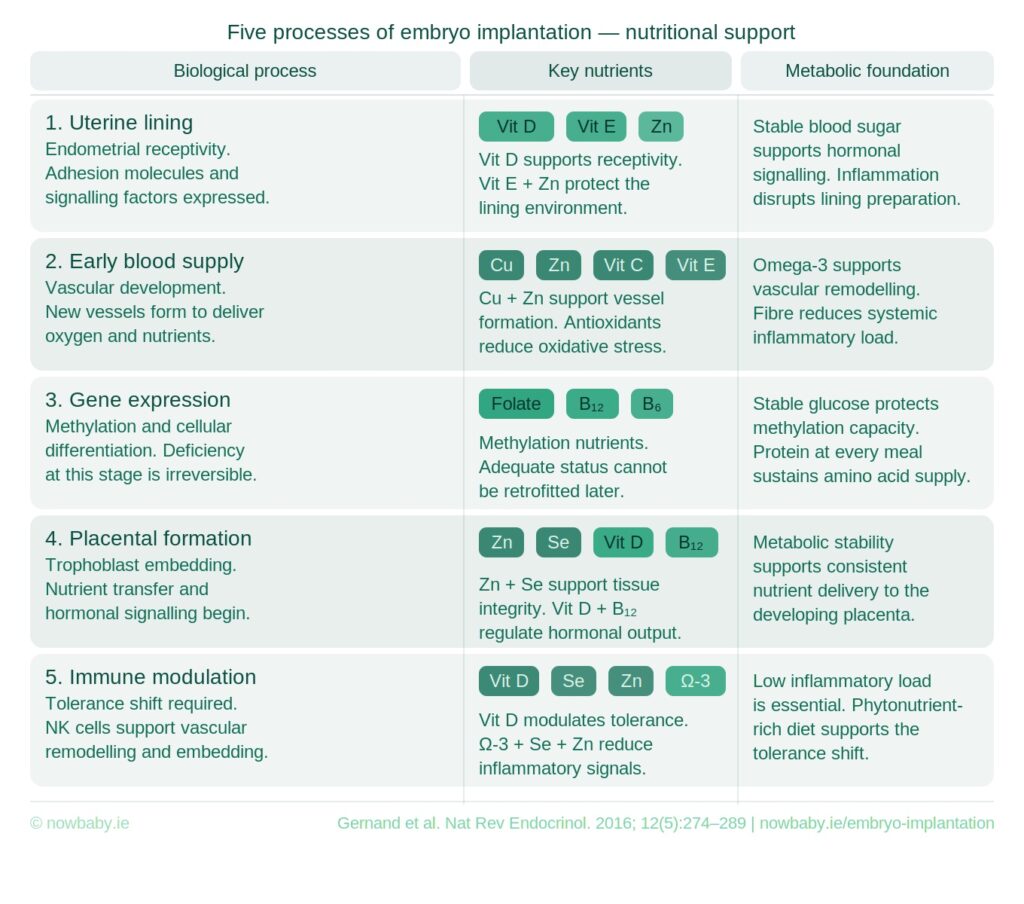 During those phases, the embryo must attach and embed, cells divide and take on specialised roles, early blood vessels develop, the immune system adapts and the first placental structures begin to form.
This work increases the demand for energy, amino acids, essential fats, vitamins and minerals. These nutrients provide the raw materials used for cell division, gene regulation, immune adaptation and early vascular development.
Providing those nutrients consistently during the implantation window is one part of the process still within your control.
The professionally created Now Baby FET Implantation Support Meal Plan turns those nutritional requirements into a complete structure for the two-week wait. Every meal is measured and balanced around the demands of the five-stage implantation process, so you are not left trying to translate scientific research into day to day meals, while waiting for your beta test..
Get the FET Implantation Support Meal Plan