
When you have one or more mosaic embryos, you may have a decision about what happens next.
You may be deciding whether to transfer one of them, which embryo should be transferred first, or whether to consider another egg collection before using the embryos already in storage.
Your mosaic result is one part of that decision. It needs to be considered alongside the embryos you already have and the options still open to you.
You may also have a euploid embryo available. Or a mosaic embryo may be your only remaining embryo.
When several mosaic embryos are available, their individual findings may affect which one is considered first.
Another egg collection may still be possible. But your current age, AMH, previous ovarian response and willingness to go through another retrieval will shape whether it is a realistic option.
Your age when the eggs were collected and your hopes for a future sibling also belong in the decision.
That is the context to take into the discussion with your clinic and genetic counsellor.
What a mosaic embryo result means
Your PGT-A report describes the chromosome pattern detected in the cells tested from your embryo.
Most human cells carry two copies of each chromosome. During PGT-A, the laboratory measures the amount of DNA associated with each chromosome and compares it with the amount expected when both copies are present.
A euploid result falls within that expected range. An aneuploid result shows a clearer gain or loss of chromosome material. A mosaic result is reported when the DNA signal falls between those two ranges.
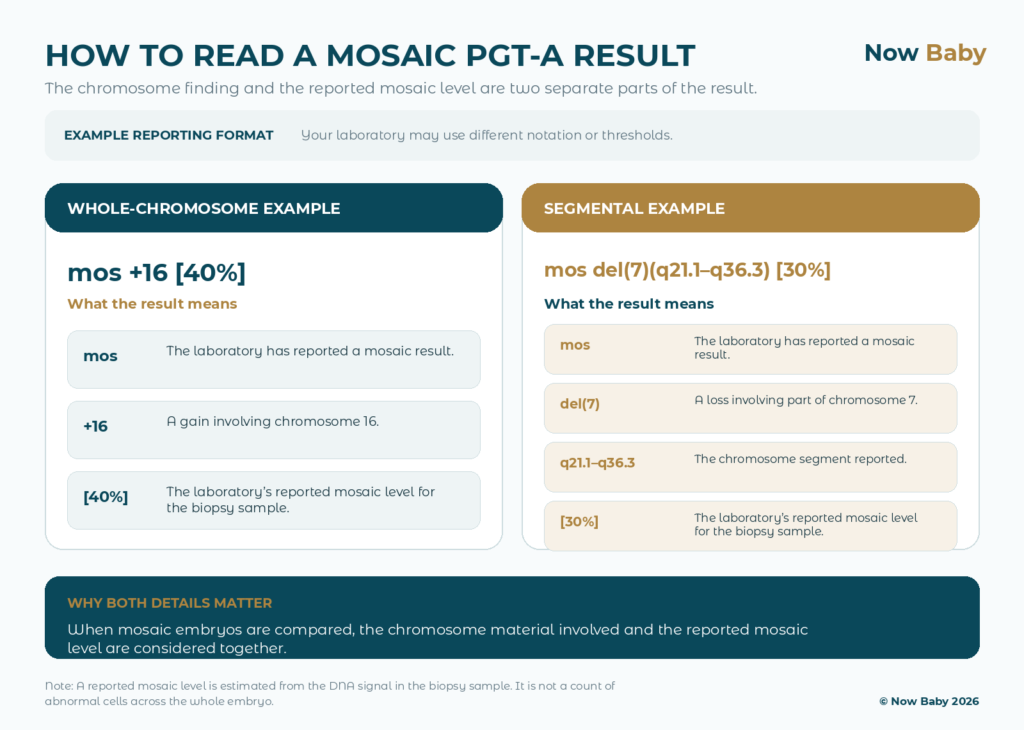
Your result may involve a whole chromosome or part of a chromosome, known as a segmental finding. It may also be reported as low-level or high-level mosaicism according to where the DNA signal falls within the laboratory’s reporting range.
The word mosaic therefore describes the chromosome pattern detected during PGT-A. The chromosome involved, the type of finding and the reported mosaic level provide the detail needed to understand your individual result.
A mosaic result therefore gives you the chromosome finding recorded by the laboratory. Before it can guide a transfer decision, you need to understand how closely the cells tested can represent the embryo they came from.
Why the biopsy cannot describe every cell in the embryo
Your PGT-A result comes from a small group of cells removed from one area of the blastocyst.
Those cells are taken from the trophectoderm, the outer layer that later contributes to the placenta. The inner cell mass, which develops into the fetus, remains inside the embryo and is not biopsied.
The laboratory analyses the combined DNA from the cells in that sample. It does not test cells from every part of the embryo.
This matters more when a mosaic result is reported because different chromosome patterns may not be spread evenly. The sampled area may contain a different mixture of cells from another area of the trophectoderm or from the inner cell mass.
The biopsy therefore shows what was detected in the cells tested. It cannot provide a cell-by-cell map of the whole embryo.
Once that limitation is clear, the next step is to consider where this embryo sits among the embryos still available to you.
Where the mosaic embryo sits among your remaining embryos
Your mosaic embryo needs to be considered alongside every other embryo you still have in storage.
You may have an embryo reported as euploid, other mosaic embryos, embryos that were not tested, or no other embryo available for transfer.
The same mosaic result can therefore lead to a different discussion depending on what remains. When it is your only embryo, it may represent a possible route to transfer. When other embryos are available, its place has to be considered in relation to those options.
This is why your clinic and genetic counsellor need to review the full embryo list rather than one report in isolation.
The first distinction is whether a euploid embryo is also available.
How an available euploid embryo changes the transfer order
When both a euploid embryo and a low-range mosaic embryo are available, the PGT-A result is considered alongside embryo morphology when deciding the transfer order.
A euploid result means the cells tested had the expected amount of chromosome material. It carries less uncertainty than a mosaic finding, but the PGT-A result is not the only factor used to decide which embryo should be transferred first.
If more than one mosaic embryo remains, the next decision is how those mosaic findings are compared with each other.
When several mosaic embryos need to be compared
When you have several mosaic embryos, your clinic needs to decide which one should be transferred first.
Each embryo has its own PGT-A result. The reported mosaic level, whether the finding involves a whole chromosome or part of one, the chromosome affected and the embryo grading may all be considered together.
These findings can place embryos differently in the transfer order, even when they are all described as mosaic.
That comparison starts with the chromosome finding and the reported mosaic level, because both can affect which embryo is considered first.
Why the chromosome finding and mosaic level both matter
When your clinic compares your mosaic embryos, it will look at two parts of each result: the chromosome finding and the reported mosaic level.
The chromosome finding shows whether the result involves a whole chromosome or part of one, and whether one or several chromosomes are involved. Segmental mosaic results have sometimes been associated with better transfer outcomes than whole-chromosome mosaic results. Embryos with several chromosomes involved may also be considered differently from those with a single finding.
The specific chromosome can also affect what your genetic counsellor needs to discuss with you and which prenatal testing options may be relevant if the transfer leads to pregnancy.
The mosaic level describes where the DNA signal from the biopsy sits between the euploid and aneuploid ranges. A lower-level result sits closer to the euploid range. A higher-level result sits closer to the aneuploid range.
Some studies have associated higher reported mosaic levels with a lower chance of implantation or ongoing pregnancy. The level is still an estimate from the cells biopsied rather than a count of abnormal cells across the whole embryo, and laboratory reporting thresholds can differ.
Both details therefore help your clinic explain why one mosaic embryo may be considered before another. The embryos in storage were also created from eggs collected at a particular age, and that age shapes the wider chromosome picture.
When another egg collection is not a simple alternative
When a mosaic embryo is available, another egg collection may appear to offer a clearer option: create a euploid embryo first and return to the mosaic embryo only if it is still needed.
But another retrieval offers the possibility of a euploid embryo, not the certainty of one.
The embryos already in storage reflect your age when those eggs were collected. A new retrieval would depend on your current age, AMH and previous ovarian response. Age affects the chance that the cycle produces a euploid blastocyst. Low AMH or a low previous response may also reduce the number of eggs available to create embryos.
In a 2024 study of 2,462 IVF–PGT-A cycles using women’s own eggs, the proportion ending without a euploid blastocyst was 22% at age 35, 58% at 40 and 92% at 44. These figures cannot predict the outcome of your cycle, but they show why another egg collection is not a guaranteed alternative to the mosaic embryo already available.
Another retrieval may create a different transfer option. It may also end without a euploid embryo, leaving the mosaic embryo already available as the option still in front of you.
The decision is therefore between transferring the mosaic embryo you have and delaying transfer for the uncertain chance of creating another option.
How many children you hope to have can change which of those choices carries more weight.
How future family plans influence which embryo is transferred first
The transfer order may affect more than your next pregnancy. It can also shape the embryos available if you hope to return for a sibling.
When one child is the goal, your clinic may focus on which embryo should be prioritised for the next transfer.
When you hope to have more than one child, the order can carry more weight. Transferring the only euploid embryo first may leave a mosaic embryo as the remaining option for a future pregnancy. Delaying transfer for another egg collection may preserve the embryos already in storage, but it also depends on what another retrieval could realistically produce now.
Your family plans therefore belong in the transfer discussion from the beginning.
Your clinic and genetic counsellor need to know whether the decision is about one pregnancy or the embryos you may need to build the family you are planning.
After You Choose, Your Body Takes Over
Whichever embryo you transfer — this mosaic embryo now, or a euploid embryo from a future retrieval — the decision you’ve been weighing ends at transfer. What happens after it doesn’t.
Implantation is a five-part sequence, and every stage has to succeed in order for pregnancy to continue.
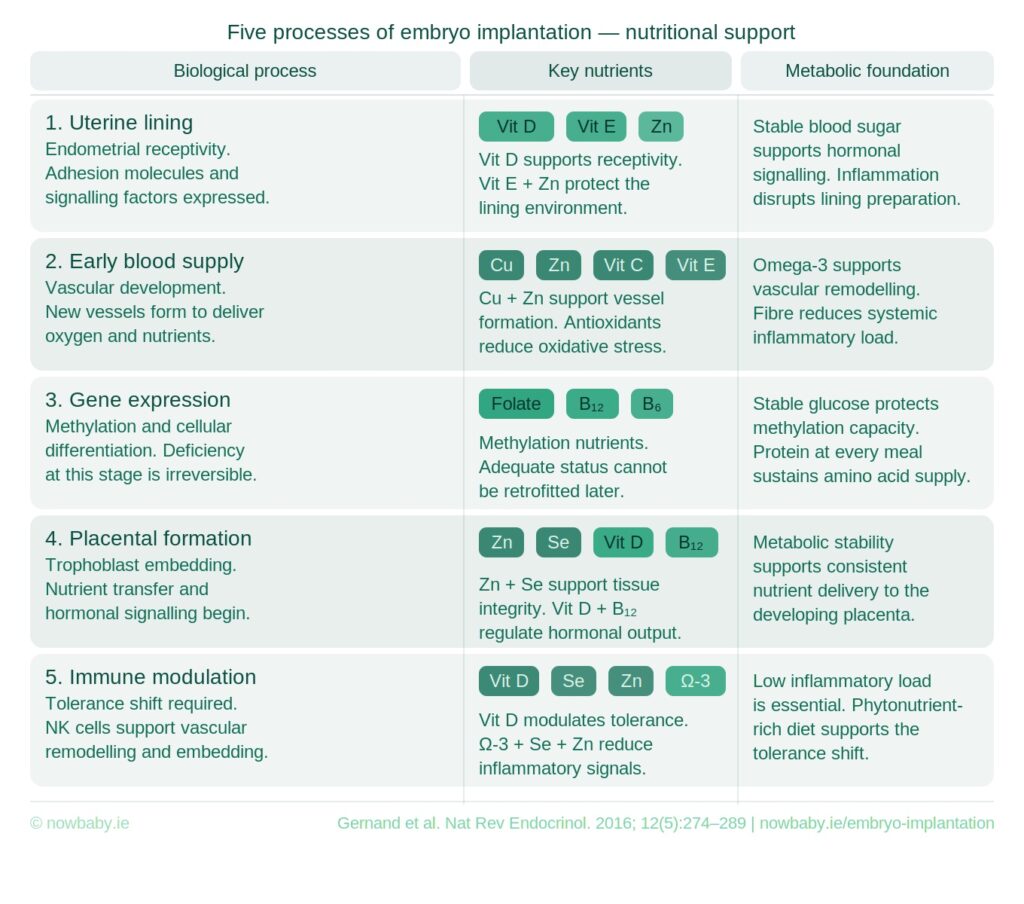
Genes switch on in a precise order. Blood vessels have to grow toward the embryo before it can draw on your circulation. Cells begin specialising into the tissue types that will eventually form a placenta. None of this is optional, and none of it happens in a single moment — it plays out over the days between your transfer and your beta test.
Each stage draws on a specific, finite supply of energy, amino acids, fats and micronutrients. That supply doesn’t arrive on its own — it depends on what you’re eating and absorbing during exactly this window.
You’ve spent this cycle being precise about which embryo to trust. The Now Baby FET Implantation Support Meal Plan lets you bring that same precision to the fourteen days that follow — every meal built around what each of these five stages specifically needs, so nothing is left to guesswork between your transfer and your beta.
Get the FET Implantation Support Meal Plan