
A missed progesterone dose before frozen embryo transfer needs prompt advice from the clinic managing your cycle.
Contact the clinic and include the progesterone name and strength, how you take it, when the dose was due, when you realised and anything you have taken since. Those details allow the team to assess the gap against the timing already planned for your lining and embryo.
When the clinic is closed, use its out-of-hours fertility contact or the written missed-dose instructions in your treatment plan. Where neither is available, send the details through the clinic portal, email or voicemail so the timeline is recorded. Use the written schedule for doses that are still due unless your clinic’s own instructions say otherwise.
Take a catch-up dose, move the next dose or change how you take your progesterone only when your clinic tells you to.
The missed dose can matter because progesterone helps set the stage of the uterine lining before transfer. Whether the plan needs to change depends on your type of FET, how you take progesterone, the length of the delay and the stage of your embryo.
Why progesterone timing matters before frozen embryo transfer
Progesterone changes the lining of the womb from a tissue that is growing into one prepared to receive the embryo.
In a medicated FET, oestrogen is usually used first to develop the lining. Progesterone then changes the activity inside it. The glands begin producing secretions needed during the implantation window, and the lining becomes more responsive to signals from the embryo.
The transfer date is planned around how long the lining has been exposed to progesterone.
A Day 3 embryo and a Day 5 blastocyst are transferred at different points because the embryo and lining need to reach the right stage together.
In a natural or modified natural FET, ovulation also helps set the timing. The corpus luteum — the structure left behind after ovulation — produces progesterone, and your clinic plans the transfer in relation to ovulation or the trigger injection. Prescribed progesterone may then be added according to your protocol.
This is why the clinic needs the exact length of the delay, the progesterone route, the type of FET and your embryo stage before deciding whether the schedule remains suitable.
If you miss a progesterone dose before FET
Send the clinic one clear medication timeline:
I was due to take [progesterone name and dose] at [time]. I realised at [time]. I have taken [anything taken since]. I use [pessary, gel, tablet or injection]. My transfer is booked for [date], and my embryo is a [Day 3 embryo or Day 5 blastocyst]. Please confirm what I should do next.
Your clinic may advise you to take the missed dose, wait for the next scheduled dose, change the timing of a later dose, arrange a progesterone blood test or review the transfer date.
How you take progesterone matters because vaginal progesterone, oral progesterone and progesterone injections reach the lining and bloodstream differently. Clinics may also combine routes within the same protocol.
Your clinic needs to look at the complete medication pattern before giving the next instruction.
Do not change your dose without clinic advice
Replacing the amount of progesterone does not recreate the original timing.
A double dose taken later creates a different interval between doses. Taking doses too close together can also increase side effects.
Changing from a pessary or gel to an injection creates another change. Each route produces a different pattern of progesterone exposure, so the medications are not interchangeable simply because they contain the same hormone.
Medication left from another cycle may also have a different strength, route or purpose.
Take a catch-up dose only when your fertility clinic specifically advises it.
Can a missed progesterone dose affect transfer?
Yes, a missed progesterone dose can matter.
Its significance varies across FET protocols.
In a fully medicated FET, prescribed progesterone creates the hormonal timing needed for the lining. In a natural or modified natural FET, progesterone produced after ovulation also contributes.
The clinic will consider:
- how long the dose was delayed
- whether one or more doses were missed
- how you take progesterone
- whether more than one progesterone route is being used
- whether ovulation occurred during the cycle
- whether you are transferring a Day 3 embryo or a Day 5 blastocyst
- how much progesterone the lining was intended to receive before transfer
The clinic may keep the transfer plan unchanged, adjust the medication timing, arrange a blood test or review the transfer date.
A missed dose is clinically relevant information. It is not a transfer result.
When to contact your clinic urgently
Here, urgent means using the clinic’s same-day or out-of-hours fertility contact rather than waiting for the next routine reply.
Use that route when:
- more than one progesterone dose has been missed
- the transfer is scheduled before the clinic next opens
- an extra or incorrect dose has been taken
- the wrong form of progesterone was used
- an injection leaked, misfired or may not have delivered fully
- the medication has run out, been damaged or stored incorrectly
- vomiting or diarrhoea may have affected oral progesterone
Heavy bleeding, severe pain, fainting or signs of a serious allergic reaction need urgent medical assessment rather than waiting for the fertility clinic.
Progesterone is not the final phase of embryo transfer
Progesterone has one specific medication job in an embryo transfer cycle. It helps prepare and maintain the uterine lining for embryo implantation.
That is important, but it is not the full implantation process.
Implantation is wider than progesterone alone. It has 5 distinct phases and each has its own nutrient requirements.
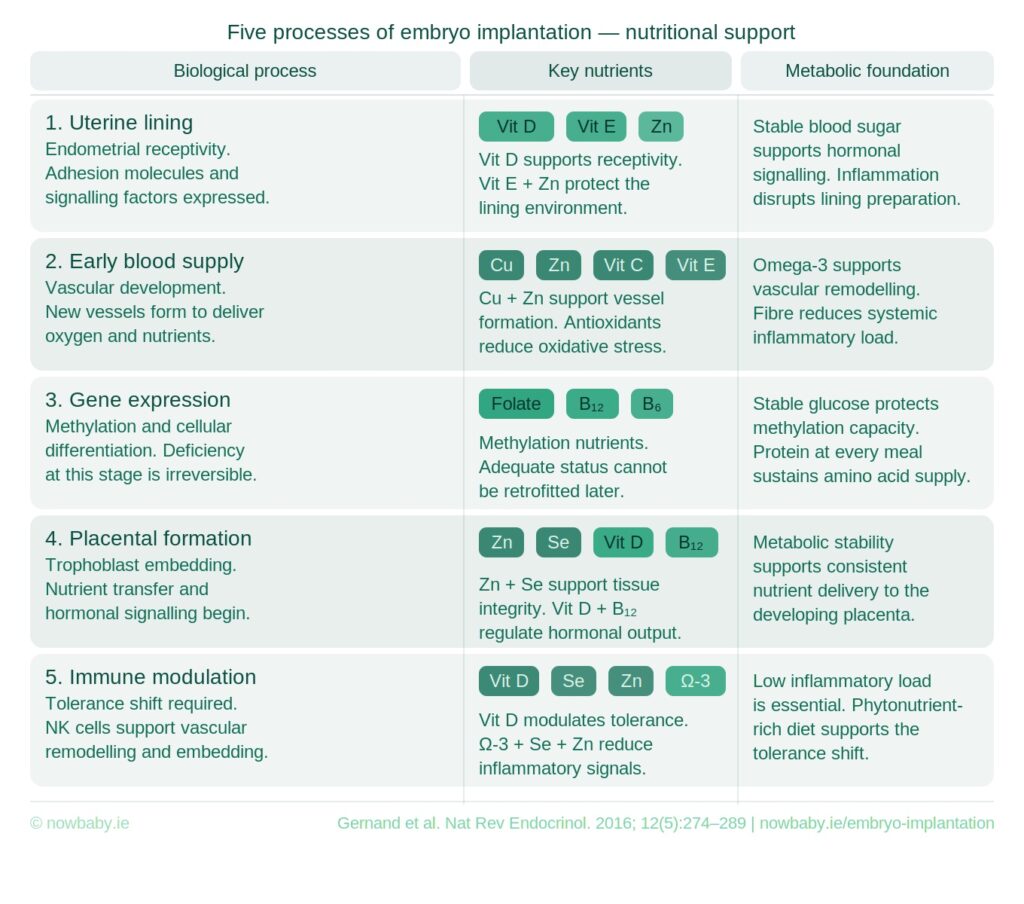 Progesterone supports the lining environment for implantation. It does not cover the full nutritional and physiological demands of the implantation process.
Each of the 5 phases must complete successfully in order for the pregnancy to continue. This process is something you can support with targeted nutrition, it is not something to simply take a supplement for.
 At Now Baby we have taken the guesswork out of it for you and created the FET Implantation Support Meal Plan.
Professionally designed to support the next phase: targeted nutrition for the 5 stage implantation process after frozen embryo transfer.
Get the FET Implantation Support Meal Plan