
After a failed first transfer, it can feel as though the odds have already moved against you.
They have not automatically changed because this is your second attempt.
Here, a failed transfer means that the pregnancy test was negative. A biochemical pregnancy or miscarriage confirms that implantation began and needs to be understood as pregnancy loss rather than failed implantation.
In 2023 UK data, the average live birth rate was 33% per frozen embryo transferred. Approximately two out of every three frozen embryo transfers did not result in a live birth.
Your first result belongs within that wider reality. The chance attached to your next FET will depend on the embryo being transferred and the conditions in which it attempts to implant.
Does One Failed Embryo Transfer Reduce Your Chances Next Time?
One negative pregnancy test cannot establish why the transfer did not work.
If the embryo was untested, a chromosome error may have prevented development from continuing. A highly graded embryo can still have a chromosome error because grading assesses appearance and developmental progress, not chromosome number.
A euploid PGT-A result reduces that particular uncertainty, but euploid embryos do not produce a live birth after every transfer. Chromosome screening cannot assess every part of embryo development or complete implantation on the embryo’s behalf.
After transfer, the embryo must continue developing while communicating with the uterine lining. Attachment, invasion, changes to the maternal blood supply, immune adaptation and early placental formation must follow in sequence.
A negative pregnancy test cannot show whether the embryo did not attach or whether development stopped before hCG reached a detectable level.
The transfer result tells you what happened. It does not tell you why.
Second Embryo Transfer Success Rates
Published second-transfer rates are difficult to compare because “second transfer” does not always describe the same treatment stage.
If your first transfer was fresh and your next will be frozen, this is your second embryo transfer overall but your first FET. Research reporting outcomes for a second FET may be describing a woman who has already had one fresh transfer and one frozen transfer.
Studies also measure different outcomes. A positive pregnancy test, clinical pregnancy, ongoing pregnancy and live birth are not interchangeable measures of success.
A 2024 study followed fresh transfers and subsequent frozen transfers using embryos from the same egg-collection cohort. The predicted positive pregnancy rates were:
- 32.8% for the first FET
- 30.8% for the second FET
- 28.9% for the third FET
- 27.1% for the fourth FET
These were positive pregnancy-test rates rather than live-birth rates. The study also involved a specific group of women and embryos, so the percentages cannot predict your result.
What they show is that meaningful pregnancy rates continued across later transfers. The chance reduced gradually rather than disappearing after the first FET.
Your clinic’s live-birth rate for embryos comparable with yours will give you a more relevant estimate. Ask whether its figure matches your embryo stage, PGT-A status, age at egg collection and intended FET protocol.
Why Success Rates Can Change Across Subsequent Transfers
Clinics usually transfer the embryo with the strongest stage and grade first.
If that transfer does not result in pregnancy, the next embryo may have a lower grade or may have reached the blastocyst stage later. The difference between first and subsequent transfer rates can therefore reflect differences between the embryos available.
Grading still cannot determine the fate of an individual embryo. Lower-graded embryos can result in live births, while highly graded embryos can produce negative pregnancy tests.
Does It Matter Whether Your First Transfer Was Fresh or Frozen?
A fresh transfer takes place within the stimulated egg-collection cycle. The ovaries have produced higher hormone concentrations, and the endometrium has developed within that hormonal environment.
A frozen embryo transfer takes place in a later cycle. The lining may be prepared through your own ovulation or with prescribed oestrogen and progesterone.
Moving to FET separates the next transfer from ovarian stimulation. This may be clinically useful, but it does not make every frozen transfer more successful than every fresh transfer. The embryo, reason for freezing and method of preparing the lining still matter.
In the 2024 same-cohort study, a negative pregnancy test after fresh transfer did not predict the result of the next frozen transfer.
For a woman moving from a failed fresh transfer to FET, that is the relevant finding: the fresh result did not establish the outcome of the remaining frozen embryos.
What Your First Transfer Can Tell Your Clinic
Your first transfer may provide information that helps your clinic plan the next one.
The review should cover:
- The stage, grade and PGT-A status of the embryo transferred
- Endometrial thickness and appearance
- Progesterone timing, dose and route
- Any progesterone blood result used by your clinic
- Missed, delayed or uncertain medication doses
- Whether the procedure was straightforward or technically difficult
- Catheter placement, blood, mucus or a retained embryo
- Previous findings involving the uterine cavity
A difficult procedure may change how the next transfer is planned. A medication or progesterone issue may justify an adjustment. A uterine-cavity concern may need further assessment.
Where the lining, medication and procedure progressed as intended, there may be no clinical reason to redesign the protocol.
A change is useful when it answers something found in the first cycle. Changing the plan simply because the result was negative can create more intervention without resolving the source of failure.
Do You Need More Tests After One Failed Embryo Transfer?
One failed transfer does not automatically justify extensive testing.
Further assessment may be appropriate when the first cycle revealed a specific concern, such as a difficult procedure, persistent lining difficulty, unexpected bleeding or a suspected uterine-cavity finding.
ERA, EMMA, ALICE, immune testing, natural killer cell testing and clotting panels are frequently offered after unsuccessful transfers. Current evidence does not support routine use after one failed transfer, and finding a difference on a test does not necessarily lead to an intervention proven to increase live birth.
The HFEA add-on reviews examine the evidence for these tests individually. They can help you separate an investigation prompted by your medical history from an add-on offered because the transfer was unsuccessful.
When More Than One Failed Transfer Changes the Clinical Picture
Repeated failure carries more weight when the embryos transferred had a higher expected chance of implantation.
Three failed euploid blastocyst transfers provide different clinical information from three failed transfers involving untested embryos. Age at egg collection, embryo stage and grading also affect what can be concluded from the number of attempts.
Current professional guidance therefore considers the expected implantation potential already transferred rather than relying on one fixed number of failures for every woman.
Once enough embryos with meaningful expected potential have been transferred without detectable implantation, a broader clinical review becomes more reasonable.
Per-Transfer and Cumulative Success Rates Measure Different Things
A per-transfer live-birth rate describes the outcome of one embryo transfer.
A cumulative live-birth rate describes the chance of at least one live birth after several transfers, or after all suitable embryos from one egg collection have been used.
The per-transfer rate is more relevant to the FET you are planning now. The cumulative rate helps explain what a group of stored embryos may offer over time.
In the 2024 same-cohort study, cumulative live birth reached 57% after the fresh transfer and up to three subsequent FETs. No individual transfer carried a 57% live-birth rate. The figure came from several opportunities combined.
This is why clinic statistics may look substantially higher when reported per egg collection rather than per embryo transferred.
Before using a published figure, check whether it measures:
- Pregnancy or live birth
- One transfer or several
- One embryo or an entire embryo cohort
- Fresh, frozen or combined treatment
- Untested or PGT-A-tested embryos
The number only becomes useful once you know what outcome and treatment period it represents.
What Will Shape the Success Rate of Your Next FET?
The embryo being transferred carries its own developmental potential.
Its age-related chromosome risk is linked to your age when the egg was collected. Its stage, grade, day of blastocyst development and PGT-A status provide further information, although none can determine the outcome alone.
The next FET must then establish the clinical conditions in which that embryo will attempt to implant:
- The uterine cavity
- Endometrial development
- Progesterone timing and exposure
- Embryo survival and development after warming
- The transfer procedure
These factors bring the embryo and endometrium to the point of transfer.
A success rate can estimate what may happen next. The implantation phase determines what happens next.
Supporting Implantation After Your Next Transfer
Implantation has 5 distinct phases and each has to complete successfully for pregnancy to continue.
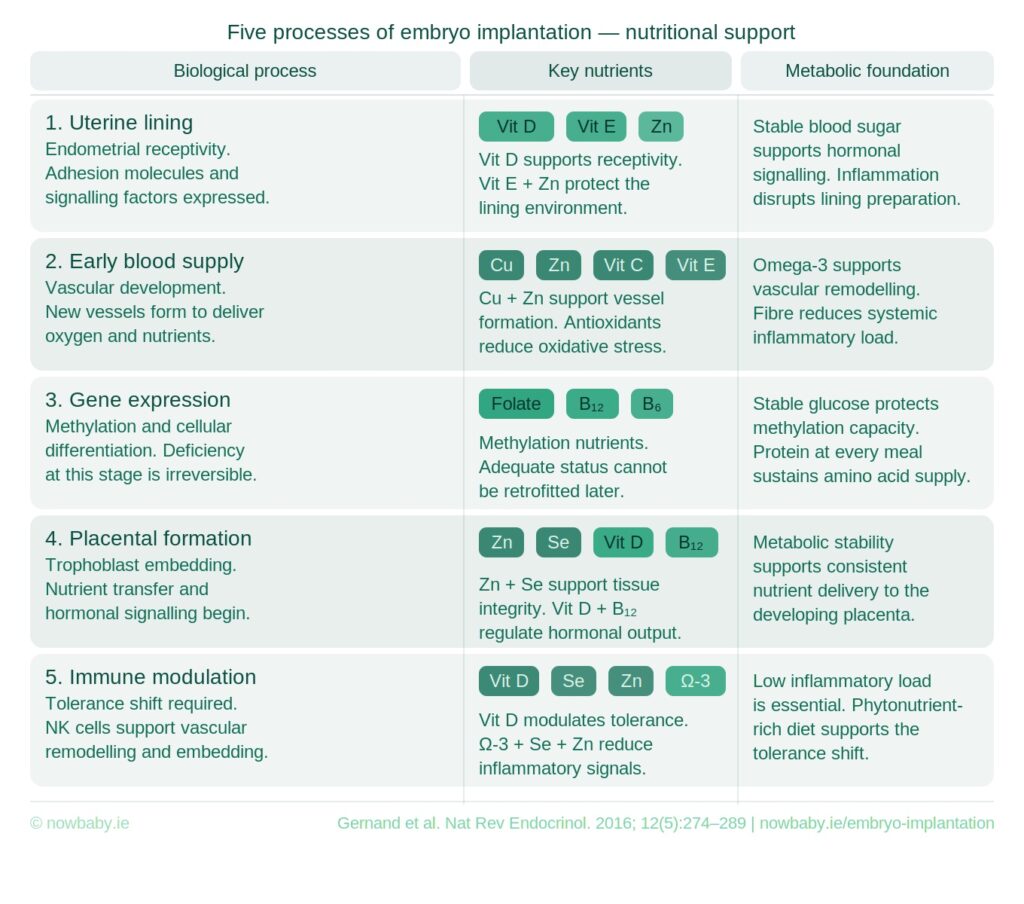
Each phase has its own nutritional requirements.
Rapid cell division requires energy and the raw materials needed to copy DNA, build proteins and form cell membranes. Amino acids contribute to new tissue. Fatty acids are used in cell membranes and cellular communication. Vitamins and minerals participate in DNA synthesis, methylation, antioxidant defence, immune adaptation and early vascular development.
Metabolic stability matters because these processes need a consistent supply of energy and nutrients while implantation progresses. Supplements cannot offer this level of support.
Your clinic manages the embryo transfer with Precision. You should do the same with your nutrition for this critical phase.
The Now Baby FET Implantation Support Meal Plan has taken all of the guesswork out for you. The nutrients needed for the full implantation phase have been professionally curated into a plan that is easily implemented.
Get the FET Implantation Support Meal Plan.