
You may have one embryo that reached the blastocyst stage on Day 5 and another that reached it on Day 6. If your clinic has placed the Day 5 blastocyst first on your transfer list, the difference of a single day can feel like a verdict on which embryo is more likely to become your baby.
It isn’t that simple.
Day 5 and Day 6 state when each embryo reached the blastocyst stage. Day 5 blastocysts generally have higher success rates across large groups, but development speed is only one part of an individual embryo’s transfer priority. PGT-A result, embryo grade, whether the transfer is fresh or frozen and your clinic’s own laboratory data can all change the comparison.
If you have embryos from both days, the decision is not whether Day 5 is always better than Day 6. It is which of your embryos has the strongest combination of features for transfer first.
What Day 5 and Day 6 Blastocyst Status Actually Means
The day refers to how long the embryo took to develop from fertilisation to the blastocyst stage.
A Day 5 blastocyst reached the stage required for transfer, freezing or biopsy five days after fertilisation. A Day 6 blastocyst reached that stage one day later. Both completed the same developmental transition, but at different speeds.
During this transition, the embryo develops a fluid-filled cavity and two distinct groups of cells. The inner cell mass will form the baby, while the trophectoderm will contribute to the placenta. The blastocyst must also expand and begin preparing to hatch from its outer shell before implantation can begin.
Reaching the blastocyst stage on Day 6 does not mean the embryo stopped developing or developed incorrectly. It means it needed more time to reach the point at which your clinic could assess, freeze, biopsy or transfer it. That extra day may carry information about developmental potential, but it does not determine the outcome on its own.
Do Day 5 Blastocysts Have Higher Success Rates Than Day 6 Blastocysts?
Across large groups of transfers, Day 5 blastocysts generally have higher implantation, clinical pregnancy and live birth rates than Day 6 blastocysts.
That difference does not mean every Day 5 embryo has greater potential than every Day 6 embryo. The figures combine embryos with different grades, chromosome results, freezing methods and transfer circumstances. They describe what happened across a population rather than predict the outcome of either embryo in front of you.
Implantation rate is usually calculated from the number of gestational sacs seen on ultrasound relative to the number of embryos transferred. Clinical pregnancy rate reports how many cycles or transfers resulted in a pregnancy confirmed on ultrasound. Live birth is the outcome that shows how many transfers resulted in a baby, so it carries more weight when comparing success rates.
Development on Day 5 is therefore a favourable feature, but not a complete transfer decision. A Day 6 blastocyst may still be the stronger embryo once its PGT-A result and grade are considered.
Why Blastocyst Development Speed May Affect Transfer Priority
Day 5 blastocysts are often placed ahead of otherwise comparable Day 6 blastocysts because transfers of Day 5 embryos have produced higher live birth rates across large study populations.
The research shows an association. It has not established that reaching the blastocyst stage on Day 5 causes the higher live birth rate or that taking until Day 6 makes an individual embryo biologically inferior.
Development day may be connected with other differences between the embryos being compared. Day 5 blastocysts are more likely, as a group, to be euploid and may also differ in grade. Laboratory procedures, embryo selection and whether the embryos were transferred fresh or frozen can influence the outcomes recorded in each group.
Development day can help estimate which embryo may have the higher chance of success, but it does not explain why one embryo will or will not result in a live birth. If two blastocysts have the same PGT-A result and a comparable grade, the population-level advantage associated with Day 5 development may be used as a practical reason to transfer that embryo first.
Day 5 vs Day 6 Success Rates When Both Embryos Are Euploid
PGT-A changes the comparison because both embryos have been reported to contain the expected number of chromosomes in the cells sampled. This removes one major reason untested Day 5 and Day 6 groups may have different success rates.
Individual studies have reported mixed results. However, the latest meta-analysis found higher clinical pregnancy and live birth rates after transfer of PGT-A-tested Day 5 blastocysts than Day 6 blastocysts. Because the studies were observational, this shows an association rather than proving that reaching blastocyst on Day 5 causes the better outcome.
This uncertainty matters when your embryos are being ranked. A Day 5 euploid blastocyst may still be prioritised when both embryos have a comparable grade because it belongs to the group associated with higher live birth rates in the pooled evidence. That is a population-based transfer decision, not proof that your Day 5 embryo is biologically stronger than your Day 6 embryo.
PGT-A result and embryo grade therefore need to remain part of the comparison. Day 5 status can help separate two otherwise similar euploid embryos, but it cannot determine which individual embryo will become a baby.
Does Embryo Grade Matter More Than Day 5 or Day 6?
Embryo grade and development day measure different features.
Day 5 or Day 6 records when the embryo reached the blastocyst stage. The grade describes how expanded the blastocyst was and how the inner cell mass and trophectoderm appeared under the microscope at the time of assessment.
Neither can identify with certainty which embryo will result in a live birth. Both are associated with transfer outcomes across large groups, but neither provides a direct measurement of everything happening inside the embryo.
There is no universal rule that grade always matters more than development day. Clinics may rank the same embryos differently because grading is subjective, laboratory protocols vary and studies have not established one transfer order for every combination of day and grade.
The comparison is simplest when both embryos have the same PGT-A result and a similar grade. Day 5 status may then be used to decide which embryo is transferred first. When a higher-graded Day 6 embryo is being compared with a lower-graded Day 5 embryo, the priority is less straightforward and should be based on the clinic’s complete ranking criteria rather than either feature alone.
A Lower-Grade Day 5 Embryo vs a Higher-Grade Day 6 Embryo
This is where a simple preference for Day 5 blastocysts stops being enough.
A lower-grade Day 5 embryo reached the blastocyst stage sooner, but its inner cell mass, trophectoderm or degree of expansion received a less favourable assessment. A higher-grade Day 6 embryo took another day to reach the blastocyst stage, but its visible structure appeared stronger when it was graded.
If both embryos have the same PGT-A result, your clinic must decide how much weight to give each feature. Some laboratories may prioritise the higher-grade Day 6 embryo. Others may place greater weight on Day 5 development, particularly when the difference in grade is small.
The grading system cannot settle this comparison on its own. Embryo grading is a visual assessment, and the same embryo may not receive an identical grade from every embryologist or laboratory. Development day is recorded more objectively, but it is still associated with outcomes across groups rather than proving the potential of your individual embryo.
Ask your clinic which embryo it recommends transferring first, what feature determined that order and whether the recommendation is supported by its own live birth outcomes for comparable embryos. That gives you the reasoning behind the ranking rather than a decision based on Day 5, Day 6 or embryo grade in isolation.
Why Fresh and Frozen Transfer Data Can Give Different Answers
A Day 6 blastocyst transferred during the egg collection cycle reaches the uterus later than a Day 5 blastocyst. By then, the endometrium has also had an additional day of exposure to progesterone and may be moving beyond the most receptive part of the implantation window.
This means lower success rates after fresh Day 6 transfer cannot automatically be attributed to the embryo. They may also reflect the timing between the embryo and the endometrium.
Frozen transfer separates the embryo transfer from the egg collection cycle. In most frozen transfer protocols, Day 5 and Day 6 blastocysts are transferred after the same duration of progesterone exposure.
For that reason, fresh and frozen transfer results should not be combined as though they are measuring the same circumstances. Frozen transfer data provide a clearer comparison of Day 5 and Day 6 embryos because the lining can be prepared to receive each embryo at the intended point in the transfer cycle. Even then, differences in PGT-A result, embryo grade and laboratory practice remain.
What a Day 6 Blastocyst Means When It Is Your Best or Only Embryo
If your Day 6 blastocyst is the highest-ranked embryo you have, the comparison with Day 5 statistics no longer determines which embryo should be transferred first. Your decision is whether to proceed with this embryo or consider creating more embryos before transfer.
Its chance of success should be estimated from its own PGT-A result, grade and your clinic’s outcomes with comparable Day 6 blastocysts. A lower average live birth rate across all Day 6 transfers cannot tell you whether this individual embryo will implant.
Your age when the egg was collected may affect the likelihood that an untested Day 6 embryo is euploid. If it has already received a euploid PGT-A result, that removes much of the age-related chromosome uncertainty from the transfer decision.
A Day 6 blastocyst has completed the development required to be selected for freezing or transfer. Its status provides useful context for estimating success, but it is not a reason to dismiss an embryo that may still result in a live birth.
Once this is the embryo being transferred, the focus moves beyond how long it took to reach the blastocyst stage. Day 6 describes its development before transfer. Implantation follows transfer, and while your blastocyst development stage is currently fixed, there is ample opportunity to support what happens next.
Once the Embryo Is Chosen, Implantation Still Has to Unfold
Implantation has 5 distinct phases and each has to complete successfully for pregnancy to continue.
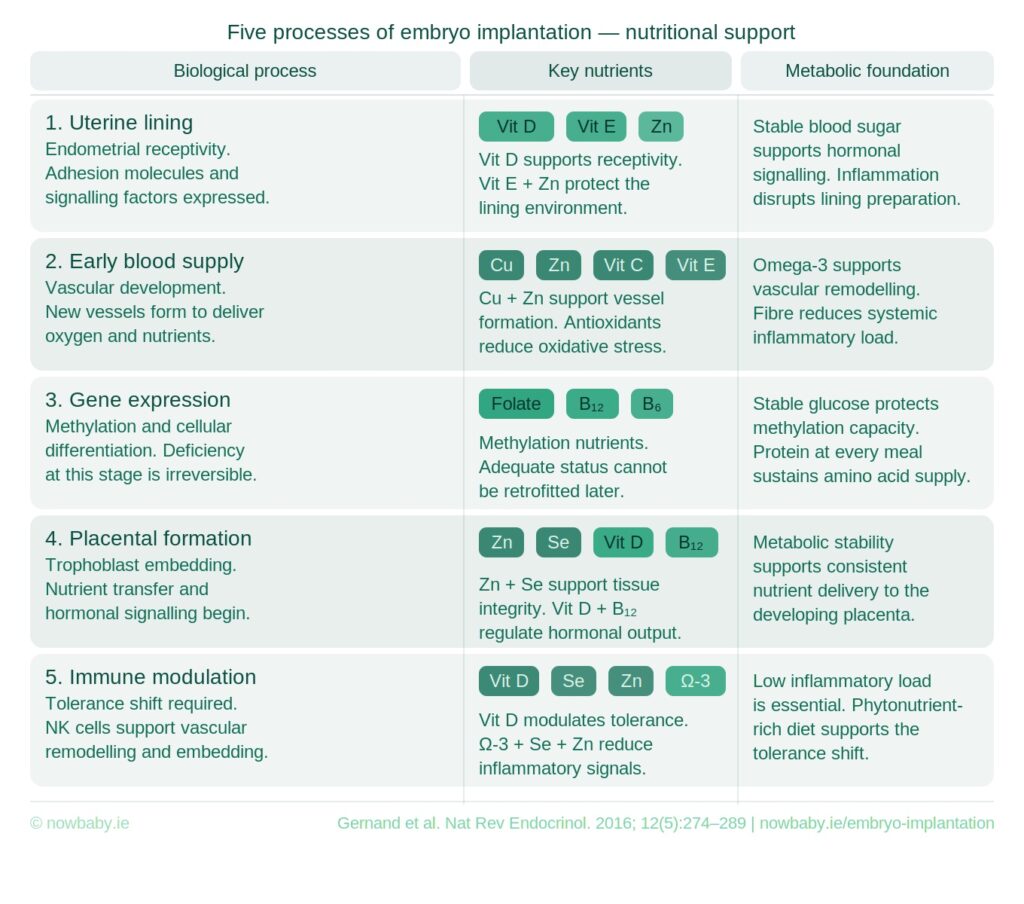
Each stage has its own nutritional and physiological demands. Cells need energy to divide, amino acids to build new tissue, essential fats to form cell membranes and specific micronutrients for blood-vessel development, gene regulation and immune adaptation. Metabolic stability affects how consistently those resources are available while this work continues.
This is not a task that supplements can deliver either. These processes depend on a consistent supply of targeted nutrients together with the metabolic stability needed to use them.
The implantation window depends on more than blastocyst development stage. There are multiple factors unfolding in a short window, the outcome of which decides whether your pregnancy progresses or not. Your clinic is not leaving anything to chance, and you shouldn’t either. The role of specific nutrients is critical to your success, and you have an opportunity to support this intentionally.
At Now Baby, we have taken the guesswork out for you and created a professionally curated FET implantation support meal plan. Each day of the two week wait before your beta test matters and what you eat during that phase matters too.
Get the FET Implantation Support Meal Plan