
When you have a high mosaic embryo, you may need to decide whether it remains in your transfer plan, whether other embryos should be prioritised first, or whether another egg collection should come before transfer.
A high mosaic result is considered more cautiously because the combined biopsy result is further from the level expected for two copies of the chromosome and closer to the laboratory’s aneuploid range than a low mosaic result.
That classification affects the decision, but it does not make it on its own.
The first step is understanding what your laboratory means by high mosaic.
What “high mosaic” means on your PGT-A report
PGT-A begins with a biopsy, but the biopsy and the chromosome analysis are two separate stages.
First, an embryologist uses a microscope to remove a small group of cells from the trophectoderm, the outer layer of the blastocyst that forms the basis of the placenta.
The microscope is used to remove the cells. It is not used to examine or count their chromosomes.
The biopsied cells are then sent to a genetics laboratory. Because the sample contains only a tiny amount of DNA, the laboratory first makes many copies of it so there is enough to analyse.
Laboratory equipment then measures how much DNA from each chromosome is present across the whole sample. Computer software compares that measurement with the amount expected when two copies of the chromosome are present.
Each of chromosomes 1–22 is expected to have two copies, one inherited from the egg and the other from the sperm. The sex chromosomes are usually XX or XY. Together, a euploid embryo has 46 chromosomes.
A cell with a full extra chromosome has 47 chromosomes. A cell missing one chromosome has 45.
PGT-A does not count the chromosomes inside each biopsied cell. The DNA from all the sampled cells is analysed together.
This is how a possible mosaic finding is identified.
For example, the expected result for chromosome 16 reflects two copies of chromosome 16 in the sampled cells.
When the combined measurement is higher than expected for two copies but lower than expected for three copies, the laboratory may interpret that as evidence that the biopsy contained a mixture:
- some cells with two copies of chromosome 16;
- some cells with three copies of chromosome 16.
The same principle applies when chromosome material appears to be missing. A result between the measurement expected for two copies and the measurement expected for one copy may suggest a mixture of cells with different chromosome numbers.
The laboratory has not seen or counted those different cells. It has measured the DNA from the biopsy as one combined sample and inferred that a mixture may be present.
Your report then describes what was found.
A result such as +16 [70%] contains three pieces of information:
- + means the result points towards extra chromosome material.
- 16 identifies chromosome 16 as the chromosome involved.
- [70%] is the laboratory’s estimate of the mosaic level in the biopsy.
The 70% does not mean that the laboratory counted the embryo’s cells and found that exactly 70% carried an extra chromosome 16.
A result reported as 70% is the laboratory’s estimate based on the combined DNA result from the biopsy. It does not mean that 70% of the embryo’s cells were counted or shown to carry the finding. Because the exact level cannot be reliably determined, ESHRE recommends describing results as low-range or high-range rather than treating the percentage as an exact cell measurement.
A report may identify a whole chromosome finding or a gain or loss affecting only part of a chromosome. That tells you what chromosome material was involved.
The mosaic percentage tells you where the combined biopsy result fell within the laboratory’s reporting scale.
A high mosaic result means that this estimate falls within the laboratory’s higher mosaic range, often above 50%. Laboratories do not all use the same cut-offs, so the classification must be read using the reporting system of the laboratory that tested your embryo.
The result therefore identifies the chromosome material involved and reports a higher-range estimate from the biopsy. It does not provide a direct cell-by-cell count of the embryo.
Why high mosaic is considered more cautiously
A high mosaic result means the biopsy produced a stronger indication of extra or missing chromosome material than a low mosaic result.
That does not confirm that the same pattern exists throughout the embryo. It does mean the result has moved further from the expected two-copy level and closer to the level associated with a full chromosome gain or loss.
Published studies generally report lower implantation and ongoing pregnancy rates after mosaic embryo transfer than after euploid embryo transfer. Several studies have also found better outcomes for lower-range than higher-range mosaic results, particularly when a 50% cut-off was used. Results vary between studies and testing systems, so they cannot create a fixed transfer ranking for one embryo.
A high mosaic embryo may still implant, continue as a pregnancy and result in the birth of a healthy baby. The lower transfer priority reflects greater uncertainty, not proof that the embryo cannot develop.
What the biopsy can and cannot tell you about the whole embryo
The biopsy tests a small group of cells from the trophectoderm. It does not test the inner cell mass that develops into the baby, and it does not test every cell in the trophectoderm.
The result can identify:
- the chromosome material involved;
- whether extra or missing material was detected;
- whether the finding affects a whole chromosome or one section;
- where the result falls within that laboratory’s reporting scale.
It cannot show how the chromosome finding is distributed across the embryo.
The cells sampled may have a different chromosome pattern from cells elsewhere in the trophectoderm. The inner cell mass may also differ from the biopsy. Technical variation during the testing process can contribute to an intermediate result as well.
A high mosaic result therefore cannot establish the chromosome pattern across the embryo. It is the laboratory’s interpretation of one small biopsy.
How an available euploid embryo changes the transfer decision
When a euploid embryo is available, it will usually be prioritised before a high mosaic embryo.
A euploid result is associated with a higher chance of implantation and a lower risk of miscarriage than a mosaic result. It also removes some of the additional uncertainty attached to the mosaic finding.
That does not make the high mosaic embryo irrelevant. It may remain frozen for later consideration if the euploid transfer does not lead to a baby or if you hope to have more than one child.
The decision is therefore not always between transferring the high mosaic embryo and discarding it. It may be a decision about transfer order.
Comparing a high mosaic embryo with low mosaic or segmental embryos
High mosaic, low mosaic and segmental do not describe three equivalent embryo categories.
High or low mosaic describes where the biopsy result falls within the laboratory’s mosaic reporting range.
Whole chromosome or segmental describes how much chromosome material is involved.
A high mosaic result can therefore be whole chromosome or segmental. A low mosaic result can also be whole chromosome or segmental.
When the other factors are similar, a clinic may prioritise a low-range mosaic embryo before a high-range mosaic embryo. This reflects the greater uncertainty attached to the higher-range result, but it is not a universal ranking rule..
Segmental findings involve only part of a chromosome. Published outcomes have sometimes been more favourable for segmental mosaic embryos than for whole-chromosome mosaic embryos, but this has not produced one universally accepted ranking system.
The full comparison needs to include the mosaic range, whether the finding is whole chromosome or segmental, how many chromosomes are involved and the other embryos available.
Why the chromosome involved may affect counselling
Your report should identify which chromosome contains the finding.
That matters because chromosome gains and losses do not all have the same biological implications.
Some whole-chromosome abnormalities are rarely compatible with implantation or continuing pregnancy. Others are associated with recognised chromosome conditions if the finding is present in the fetus.
The chromosome involved may also affect which prenatal tests are discussed if the embryo is transferred and pregnancy continues.
This information can shape counselling, but it cannot establish the outcome of the embryo. Current evidence does not support a universal transfer ranking based only on the chromosome number.
A genetic counsellor can explain the specific finding on your report without turning population-level risk into a prediction for your embryo.
What embryo grading contributes to the wider comparison
Embryo grading describes how the blastocyst developed and how its visible structures appeared before freezing.
It assesses features such as expansion, the inner cell mass and the trophectoderm. It does not examine chromosome number.
A stronger grade may add useful information when two embryos have similar PGT-A findings.
The reverse is also true. A lower-grade mosaic embryo may still have reproductive potential.
Grading therefore contributes to transfer priority, but it should be interpreted alongside the genetic result rather than used to replace it.
How age at egg collection shapes the remaining embryo picture
The age that matters to the chromosome status of an embryo is your age when the egg was collected.
The embryo does not continue ageing while frozen.
If your high mosaic embryo was created from eggs collected several years ago, it reflects the egg biology of that earlier age. A new retrieval would use eggs at your current age.
That distinction becomes important when comparing an embryo already available with the possibility of creating another embryo now.
Another retrieval may produce a euploid embryo. It may also produce fewer eggs, fewer blastocysts or no embryo with a stronger PGT-A result.
Age at egg collection therefore helps explain the embryo you already have. Current age helps estimate the uncertainty of trying to create an alternative.
How current age, low AMH and previous ovarian response affect the prospect of another retrieval
A recommendation for another retrieval only becomes meaningful when it is connected to your likely ovarian response.
Current age affects the chance that a newly created embryo will be euploid.
AMH and antral follicle count help the clinic estimate how many follicles may respond to stimulation. Your previous retrievals show what happened when your ovaries were actually stimulated.
The most useful questions are practical:
- How many eggs were collected before?
- How many were mature?
- How many fertilised?
- How many reached blastocyst?
- What were the PGT-A results?
- Has your AMH or antral follicle count changed since then?
A high mosaic embryo already exists. Another retrieval offers a possibility, not a guaranteed replacement.
When another egg collection may offer little certainty
Another egg collection may be reasonable when there is a realistic prospect of creating an embryo with a clearer transfer priority.
It may offer much less certainty after repeated low ovarian response, repeated cycles without blastocysts or repeated cycles in which no euploid embryos were created.
The physical, emotional and financial cost also belongs in the decision.
A further retrieval does not have to be dismissed because the outcome is uncertain. IVF always contains uncertainty.
But uncertainty must work in both directions. The high mosaic embryo has an uncertain outcome, and another retrieval may also fail to produce a transferable embryo.
The comparison is between two real options, not between an uncertain embryo and a guaranteed better one.
When a high mosaic embryo is the only embryo left to consider
When a high mosaic embryo is the only embryo remaining, the decision changes.
There is no euploid or low mosaic embryo to transfer first. The comparison may now be between transferring this embryo, attempting another retrieval, using donor eggs or ending treatment.
A high mosaic result does not oblige you to transfer the embryo. It should not automatically remove the embryo from consideration either.
The decision requires clear information about the specific PGT-A finding, the clinic’s transfer policy, the possibility of another retrieval and the level of uncertainty you are prepared to carry.
For some women, transfer will remain a meaningful option. For others, the genetic uncertainty or pregnancy implications will be more than they wish to accept.
Both decisions deserve informed counselling rather than pressure.
How future family plans affect the decision
The decision may look different when you are hoping for one child than when you hope to have two or more.
If a euploid embryo is available, transferring it first may be the clearest immediate priority. But transferring before another retrieval also means returning for egg collection later at an older age if you want another child.
Embryo banking may therefore be discussed before transfer when current ovarian response still makes another retrieval realistic.
When response is already very limited, delaying transfer for repeated retrievals may offer little additional certainty.
Future family plans do not determine the correct answer. They change what needs to be protected within the decision: the next transfer, the chance of another embryo or both.
Questions to discuss before deciding whether to transfer
Before making the decision, ask your clinic or genetic counsellor:
- Which chromosome or chromosome section is involved?
- Does the result show extra or missing chromosome material?
- Is it a whole-chromosome or segmental finding?
- Is one chromosome involved or more than one?
- What mosaic percentage or range did the laboratory report?
- How does that laboratory define low and high mosaic?
- Could the same result have been classified differently by another laboratory?
- How does this embryo compare with every other embryo available?
- What does the embryo grade add to that comparison?
- Does the clinic transfer high mosaic embryos?
- What pregnancy outcomes has the clinic seen after these transfers?
- What prenatal testing would be discussed if pregnancy continues?
- Based on your current age and previous response, what is another retrieval realistically expected to produce?
- Would genetic counselling change or clarify any part of the decision?
The purpose of these questions is not to remove every uncertainty. It is to make sure the decision is based on your embryo, your remaining options and your family plans rather than the word high alone. ASRM recommends specialist genetic counselling for women considering mosaic embryo transfer.
Your Opportunity to Support Implantation
If the decision is to move ahead with transfer of your high mosaic embryo, you will want to know what can still be done to support implantation
Implantation has 5 distinct phases and each has to complete successfully for pregnancy to continue.
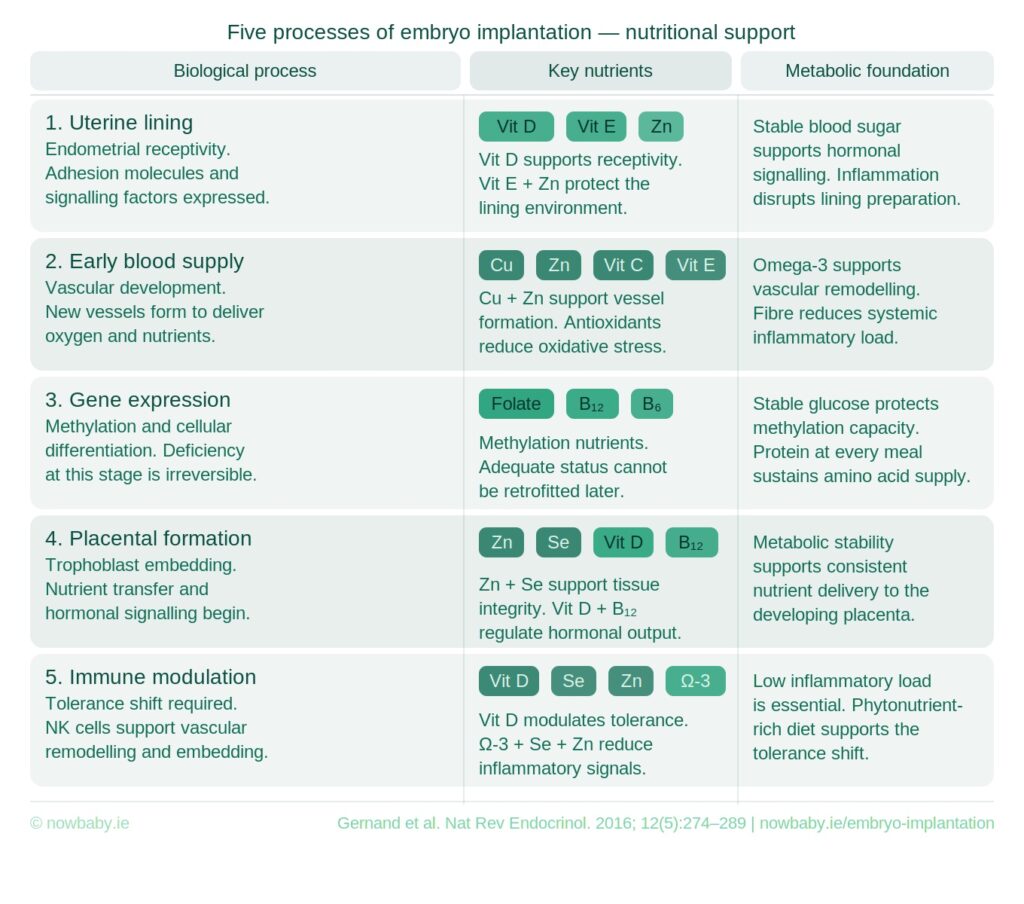
Each phase has its own nutritional requirements. Cells need energy to divide, amino acids to build new tissue, essential fats to form cell membranes and specific micronutrients for early blood-vessel development, gene regulation, placental formation and immune adaptation.
The PGT-A result and embryo selection are already determined. Providing those nutrients consistently during the implantation window is one part of the process still within your control.
The professionally created Now Baby FET Implantation Support Meal Plan turns those nutritional requirements into a complete structure for the two-week wait. Every meal is measured and balanced around the demands of the five-stage implantation process, so you are not left trying to translate scientific research into day-to-day meals while waiting for your beta test.
Get the FET Implantation Support Meal Plan.