
Realising you have missed a progesterone dose after FET can make one mistake feel bigger than the entire protocol you followed to reach transfer.
Before beta, the fear is that you have disrupted implantation. After a positive beta, the fear is for the pregnancy your result has confirmed.
The missed dose is the same, but the question it creates is different.
Before Beta, Progesterone Is Supporting Implantation
Before beta, progesterone is keeping your uterine lining in the receptive state your embryo needs as it attaches and embeds. It drives decidualisation, the process that changes lining cells into specialised tissue around the implantation site. This tissue helps regulate how your embryo moves into the lining, local immune activity and the remodelling of blood vessels around it.
In a medicated FET, the progesterone you take is providing this support because the cycle is usually created without ovulation and without a corpus luteum producing progesterone. In a natural or modified natural FET, your corpus luteum also produces progesterone, while prescribed progesterone may be added as luteal support.
That difference is part of what your clinic needs to assess when a dose is missed. The type of FET, the progesterone product and route, when the dose was due and how long the gap has been all shape the advice you need next.
What to Do If You Miss Progesterone Before Beta
When you realise a progesterone dose has been missed, contact the clinic managing your FET with the exact timeline. Tell them the name and strength of your progesterone, how it is administered, when the dose was due, when you noticed and what doses you have taken since.
“Missed a dose” does not describe the size of the gap or how it fits into your prescribed schedule. Those details allow your clinic to assess what happened and tell you how to continue.
When the clinic is closed, use the out-of-hours contact or the missed-dose guidance supplied with your treatment protocol. Advice given to another IVF patient cannot answer this safely because her medication, timing and FET protocol may not match yours. Progesterone support is prescribed through different routes and regimens, so the next step must come from the team managing your cycle.
Can One Missed Progesterone Dose Affect Implantation?
One missed dose may reduce the progesterone exposure planned by your clinic for part of the implantation window. How much that matters depends on the length of the gap, how progesterone is administered and whether your FET cycle also has progesterone production from a corpus luteum. Your clinic assesses those details against the full pattern of doses already taken. Progesterone remains critical for endometrial support and implantation, but the significance of one missed dose has to be interpreted within your complete protocol.
Progesterone provides the hormonal support only. Implantation has 5 distinct phases and each has to complete successfully for pregnancy to continue.
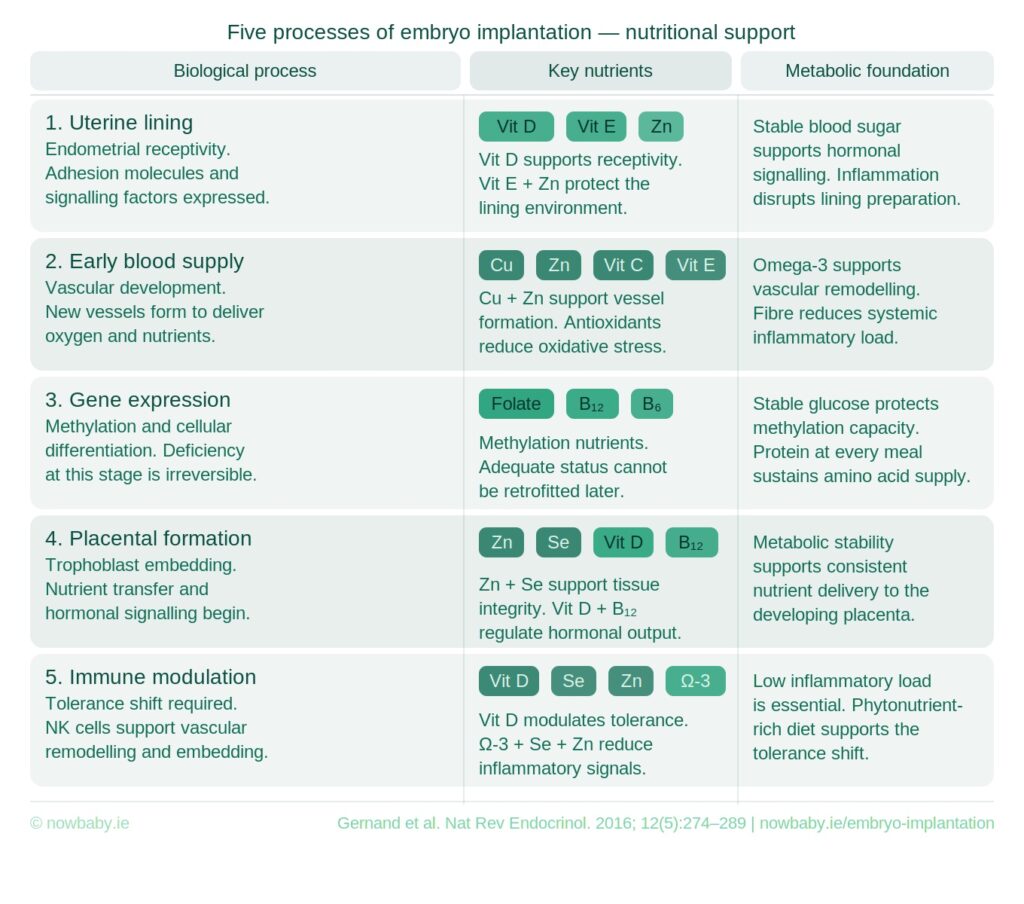 Each stage has its own nutritional and physiological demands. Cells need energy to divide, amino acids to build new tissue, essential fats to form cell membranes and specific micronutrients for blood-vessel development, gene regulation and immune adaptation. Metabolic stability affects how consistently those resources are available while this work continues.Hormones cannot complete these five processes.
This is not a task that supplements can deliver either. These processes depend on a consistent supply of targeted nutrients together with the metabolic stability needed to use them.
Embryo implantation beyond hormone support
The implantation window depends on more than progesterone. There are multiple factors unfolding in a short window, the outcome of which decides whether your pregnancy progresses or not. Your clinic is not leaving anything to chance, and you shouldn’t either. The role of specific nutrients is critical to your success, and you have an opportunity to support this intentionally.
At Now Baby, we have taken the guesswork out for you and created a professionally curated FET implantation support meal plan. Each day of the two week wait before your beta test matters and what you eat during that phase matters too.
Get the FET Implantation Support Meal Plan
After a Positive Beta, Progesterone Is Supporting Early Pregnancy
After a positive beta, progesterone continues to maintain your uterine lining while the pregnancy develops and the placenta begins to form.
In a natural or modified natural FET, hCG from the pregnancy signals the corpus luteum to keep producing progesterone. In a fully medicated FET, ovulation did not create a corpus luteum, so prescribed progesterone remains the source of that hormonal support.
The placenta gradually takes over progesterone production during the first trimester. The stop date in your protocol is set around this hormonal handover.
A missed dose after beta therefore has to be assessed within the source of progesterone in your cycle and how far the pregnancy has progressed.
What to Do If You Miss Progesterone After a Positive Beta
After a positive beta, contact the clinic managing your progesterone support with the exact medication timeline. Include the progesterone name and strength, how it is administered, when the dose was due, when you realised it had been missed and every dose taken since.
The clinic also needs to know how far the pregnancy has progressed and whether your FET was natural, modified natural or fully medicated. Those details show whether progesterone is coming from a corpus luteum, prescribed medication or a combination of both, and allow the missed dose to be assessed within the support available at that stage.
When your fertility clinic is closed, use its out-of-hours contact or the missed-dose guidance supplied with your protocol. If your care has already transferred to another maternity service, contact the team now responsible for your early pregnancy. The next step needs to come from a clinician who knows your FET protocol and current progesterone prescription.
Can One Missed Progesterone Dose Cause Miscarriage?
After a positive beta, missing progesterone can feel as though one mistake has put the pregnancy you have worked so hard to reach at risk. The significance of that missed dose depends on the progesterone support available across your full protocol and how far the pregnancy has progressed.
Research has linked lower progesterone exposure in programmed FET cycles with poorer pregnancy outcomes. Those studies measure progesterone levels or compare complete support regimens. They do not isolate one missed dose after a positive beta, so they cannot calculate the miscarriage risk created by that single event.
The length of the gap, how progesterone is administered and whether progesterone is also being produced by a corpus luteum all shape the support available during that time. Your clinic will assess those details alongside the follow-up used to monitor your pregnancy.
One missed dose is not evidence that you caused harm.
The Outcome of Your Pregnancy Relies on More Than a Single Progesterone Dose
Your pregnancy is supported by the full pattern of progesterone exposure across your protocol, the source of progesterone available in your cycle and the development already underway. A missed dose is one part of that wider picture.
Giving your clinic the exact timeline allows them to assess the gap properly and guide what happens next. You do not have to carry the meaning of that missed dose alone.
One moment in a carefully managed protocol does not define the outcome of your pregnancy.