
Choline is one of the nutrients responsible for building and maintaining the structure of egg and sperm cells. Food plays two distinct roles in the body. It provides energy to sustain daily life, and it supplies the structural materials that allow cells to form, organise, and communicate reliably over time. Choline belongs firmly in this second category.
Often overlooked, choline is a foundational nutrient involved in the construction and maintenance of cells. Its role begins long before pregnancy and continues across all stages of reproductive preparation. Choline supports the physical organisation of cells, the integrity of cell membranes, and the signalling processes that allow tissues to function coherently.
In fertility physiology, these processes are active continuously. Egg development, sperm production, and early embryonic organisation all depend on accurate cellular structure and communication. Choline contributes quietly to this underlying order.
Understanding choline as a structural nutrient helps place it accurately within fertility nourishment: foundational, ongoing, and essential.
What Is Choline?
Choline is an essential nutrient, meaning it must be obtained through the diet. While sometimes grouped with B vitamins, it is a distinct nutrient with unique biological functions.
Choline is a key component of cell membranes and is required for the formation of phospholipids that give cells their structure and flexibility. It also contributes to the production of acetylcholine, a signalling molecule involved in communication between cells.
Choline supports lipid transport, membrane integrity, and cellular organisation throughout the body. These functions are fundamental to tissues that undergo regular renewal and differentiation.
This definition reflects choline’s general biological role, independent of fertility.
How Much Choline Does the Body Require?
The European Food Safety Authority (EFSA) sets an Adequate Intake (AI) for choline of 400 mg per day for adult women and 550 mg per day for adult men. During pregnancy, the AI increases to 480 mg per day to reflect higher physiological demand.
An Adequate Intake represents the average daily amount assumed to be sufficient to maintain normal physiological function in the general population. It is not a personalised target and does not account for individual variation in demand or utilisation.
Choline is used continuously in tissues that rely on structured cell membranes and active signalling. During periods of sustained cell division and tissue preparation — including reproductive processes — choline demand is ongoing.
For this reason, choline adequacy is best understood as steady availability over time, supported through consistent nourishment.
The Role of Choline in Fertility
Choline contributes to fertility through its role in cellular structure and organisation.
In egg development, choline supports the formation and maintenance of cell membranes, which are essential for normal oocyte maturation and cellular signalling. These processes unfold over extended periods prior to ovulation.
In sperm production, choline contributes to membrane integrity and the structural stability of sperm cells, supporting accurate cell formation during spermatogenesis.
Following conception, choline continues to support early embryonic organisation. Rapid cell division and differentiation rely on intact membranes and coordinated signalling, both of which depend on adequate choline availability.
Across fertility physiology, choline supports structural continuity and reliable cellular communication.
Food Sources of Choline
Choline is found primarily in whole foods that contain both protein and fat.
Rich sources include eggs (particularly the yolk), liver, oily fish, poultry, and dairy products. Smaller amounts are present in legumes, cruciferous vegetables, and some whole grains.
Eggs are one of the most accessible and concentrated dietary sources of choline and already feature in fertility-supportive meal patterns.
Because choline is part of cell membranes, it naturally appears in foods that provide structural nutrients rather than isolated components.
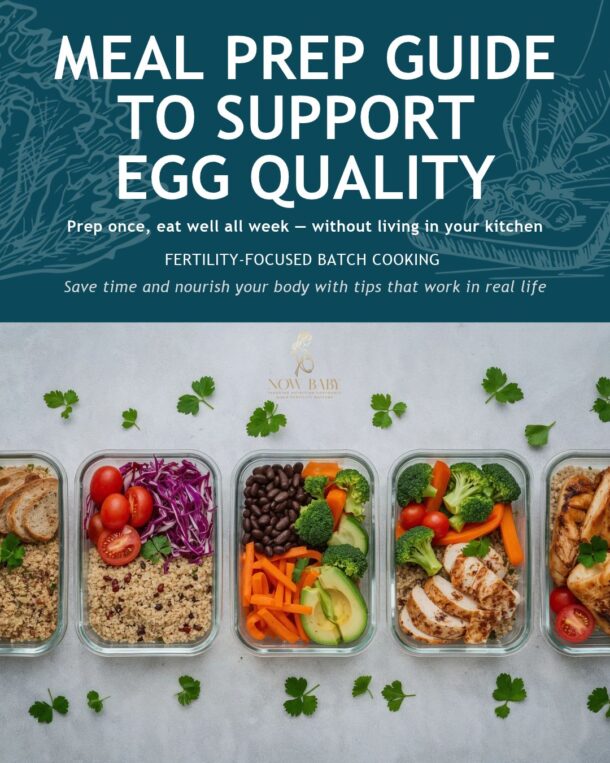
Once you start looking at fertility nutrients individually, the list gets long very quickly. Choline is only one part of it. Egg and sperm development are already underway during the roughly three months before conception, so the nutritional opportunity lies in what you eat repeatedly during that development window — not in trying to remember and add every nutrient separately.
That is why meal planning and preparation are part of the 90-day nutrition framework I use with couples who are trying to conceive. It makes it easier to bring protein, fats, fibre and a wide range of micronutrients together in real meals throughout the week:
- All your shopping for the week can be done at one time, saving you hours.
- By prepping everything in one go, more time is saved.
- By having meals that lend themselves to either being frozen for future use or being good for lunch the next day, less time is spent in the kitchen.
- You save money too, as there is less waste, spoiled food and fewer lunches bought out.
- And, of course, the meals are planned around the foods you want to be eating before conception.
What Depletes Choline — and What Enhances Absorption
Choline availability is influenced by everyday dietary patterns and physiological demand.
High levels of physical demand, including sustained or intense exercise, increase choline utilisation as cell membranes are remodelled and repaired. Alcohol consumption also increases choline requirements, as choline is used in pathways involved in lipid transport and liver metabolism.
Low intake of choline-rich foods can reduce supply over time. Periods of increased cellular turnover, stress, or inflammation can increase utilisation. Diets that rely heavily on highly processed foods tend to provide less naturally occurring choline.
Choline absorption and utilisation are supported by whole-food contexts. Choline is naturally present in foods that also contain fat and other structural nutrients. This reflects how cells are built — using coordinated materials rather than isolated parts.
When foods are processed to remove elements such as fat or yolk, individual nutrients may still be present, but the context that supports their use can be diminished. Preserving whole foods supports more reliable nutrient utilisation.
How to Get These Nutrients From Your Meals
By the time you have thought about choline, folate, omega-3 fats, iron, zinc and the rest, fertility nutrition can become a long list of separate things to remember, and supplementing them all individually can quickly create an enormous stack.
Meals give you a much simpler way to approach it. One meal can provide protein, fats, fibre and several micronutrients together, and those combinations can be repeated across the weeks before conception.
Egg and sperm development takes place over the months before conception. A 90-day nutrition framework works with that natural development window, providing consistent nutritional input while those cells are developing.
The Mediterranean Fertility Nutrition Protocol brings those requirements together across those 90 days for both partners, with the nutritional targets and daily structure already worked out.

Get the Mediterranean Fertility Nutrition Protocol