Two in three untested frozen embryo transfers do not result in a live birth.
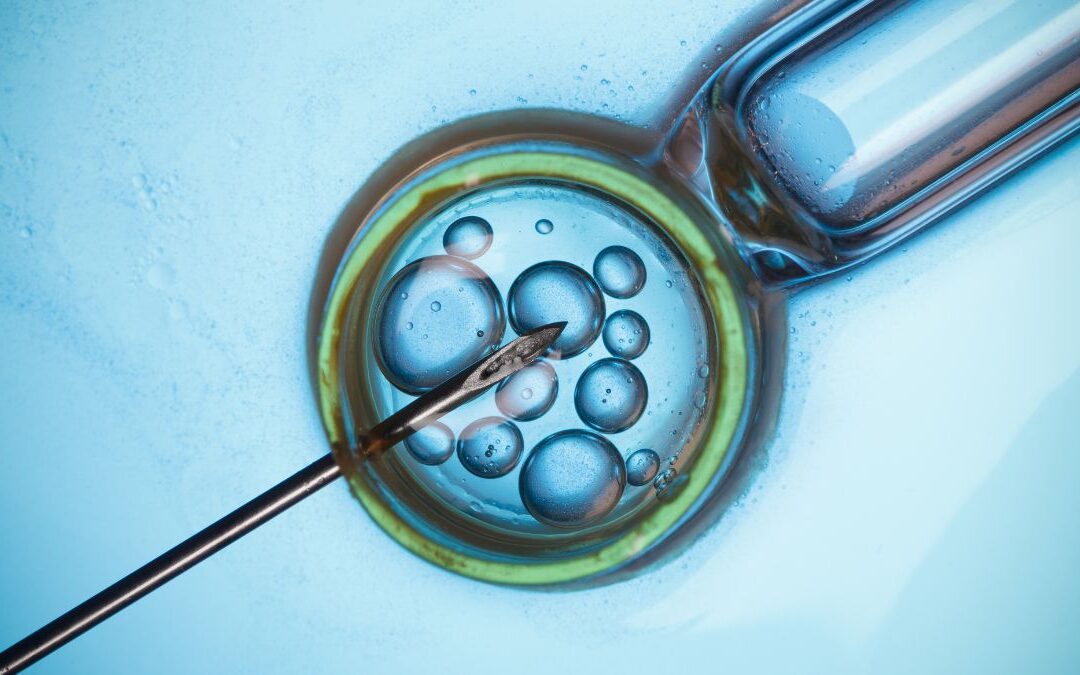
Embryo implantation after frozen embryo transfer is often described as the moment the transferred embryo attaches to the uterine lining.
But attachment alone does not determine whether a pregnancy continues.
An embryo can form.
Cell division can begin.
A pregnancy test can turn positive.
And yet, development can stop.
When this happens, the focus usually returns to egg quality or sperm health.
Those matter. But fertilisation is not the same as stabilisation.
The embryo has been selected. Your lining has been measured. Progesterone has prepared the implantation window and the transfer procedure has placed the embryo inside your uterus.
This is not a time to sit and wait.
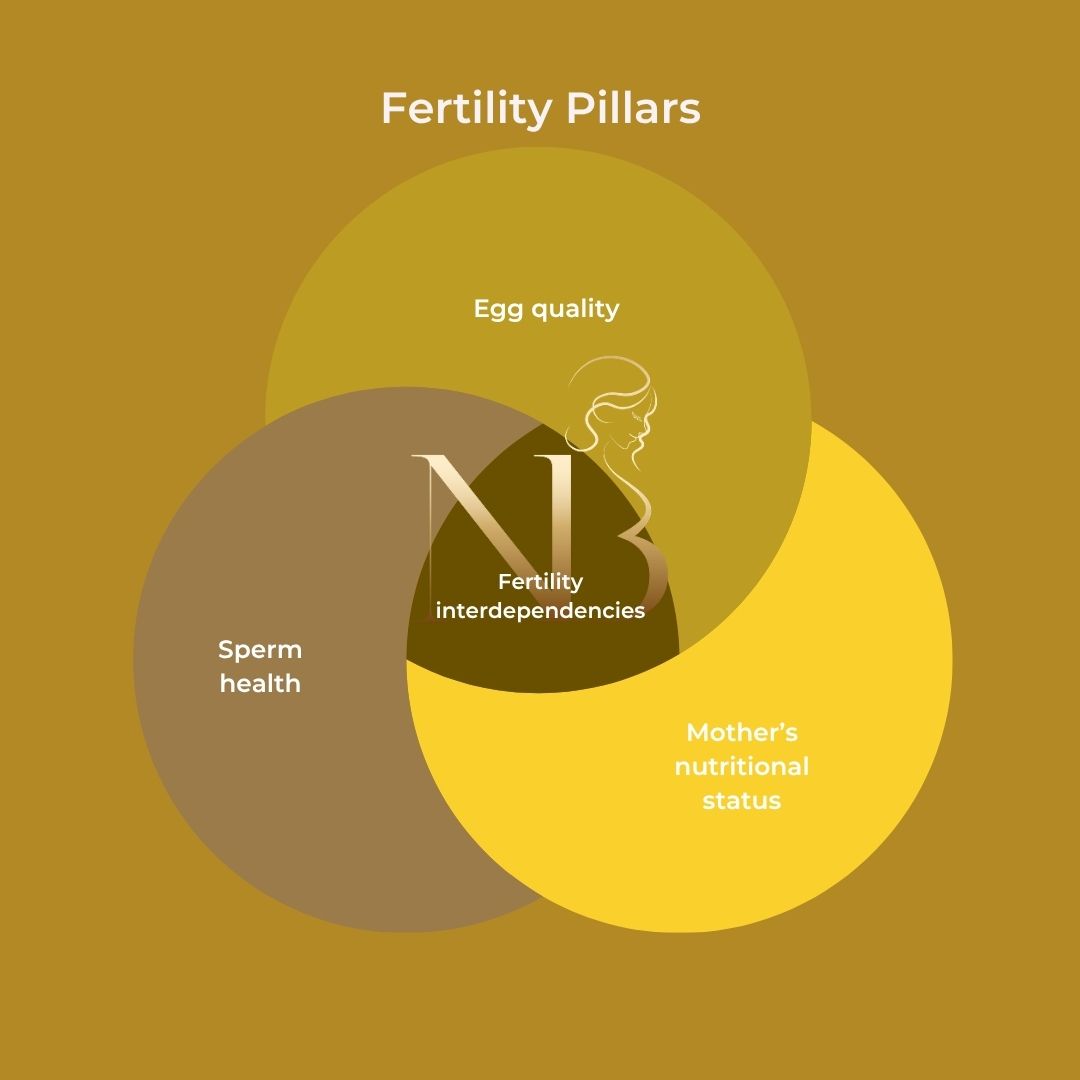
Egg quality and sperm health are two of the three conditions that determine whether this pregnancy continues. What happens in your body from here is the third — and it carries equal weight, not a supporting role.
For pregnancy to continue, several biological processes must now unfold in sequence — and they must be supported within the maternal body.
What Embryo Implantation Actually Requires
Implantation is not a single event after embryo transfer. It is a sequence of biological processes through which the embryo and uterine lining begin building the connection needed to sustain pregnancy.
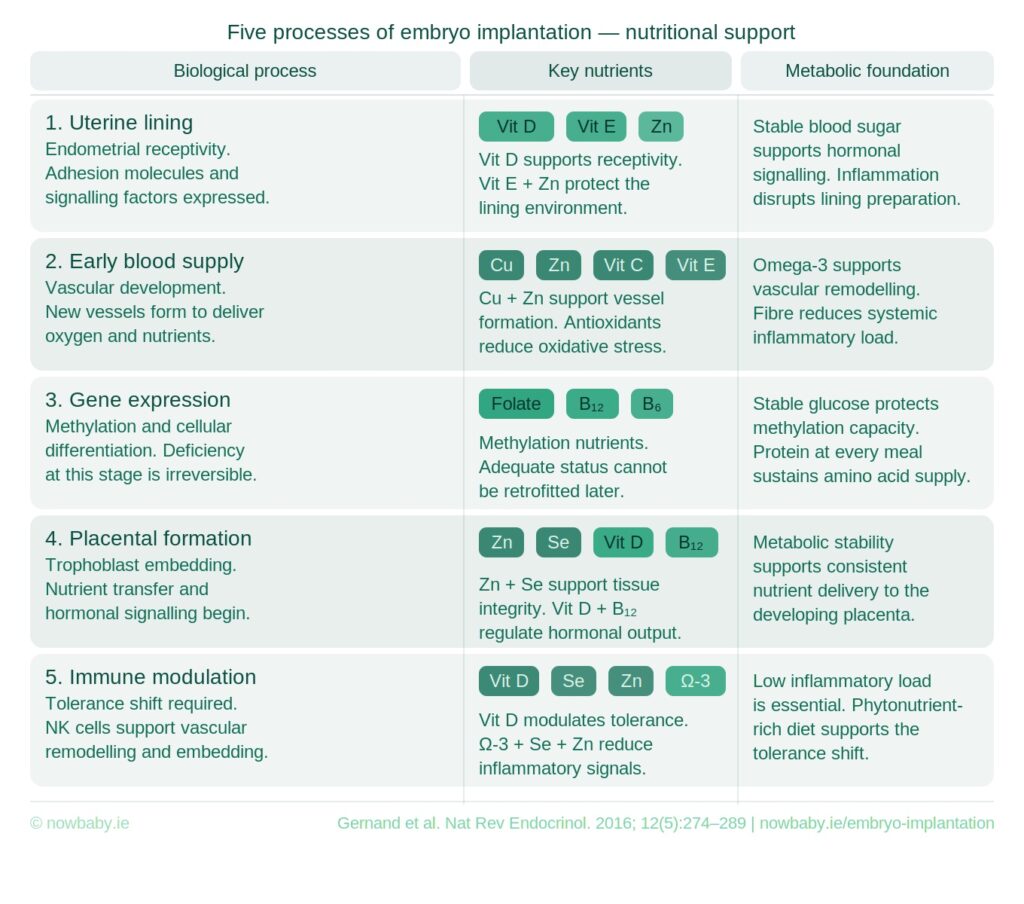
Implantation has 5 distinct phases and each has to complete successfully for pregnancy to continue.
Uterine lining receptivity
The transfer is timed to place the embryo inside the uterus during a short progesterone-dependent window.
During this window, the uterine lining expresses the adhesion molecules and signalling factors that allow the embryo to make contact, attach and begin embedding. Progesterone prepares this receptive state, but the lining must also respond to that hormonal instruction.
The embryo and lining then begin communicating at a cellular level. This first contact determines whether attachment can progress into implantation.
Building this receptive surface is itself a nutrient-dependent process — the lining’s ability to express the right adhesion signals at the right moment depends on the amino acid and micronutrient supply available to it in that window.
Establishing an Early Blood Supply
As your embryo begins embedding, its relationship with the maternal circulation starts to develop.
Cells surrounding the embryo release signals that influence nearby blood vessels. Those vessels begin adapting and remodelling so that oxygen and nutrients can reach the developing tissues as cellular activity increases.
This early vascular development is part of implantation itself. Attachment may bring the embryo into contact with the lining, but an expanding blood supply is needed to support what follows.
New vessel growth of this kind draws directly on iron, zinc and copper — the maternal supply available at this exact phase shapes how efficiently that blood supply can establish.
Regulating Gene Expression and Cellular Differentiation
From the earliest days after transfer, cells are dividing and specialising.
Differentiation into blood cells, bone cells and brain cells begins long before a scan confirms pregnancy. These changes accelerate during the first eight weeks after conception
Gene expression must be tightly regulated for this process to unfold properly. That regulation depends on adequate methylation capacity and micronutrient availability, including folate, vitamin B12 and choline.
When these regulatory processes are constrained, development may begin but struggle to progress.
Beginning Placental Formation
The outer cells of the embryo begin embedding into the lining and form the early placenta.
This structure is responsible for nutrient transfer, hormonal signalling and continued vascular development. Placental formation is not a late event. It begins almost immediately after implantation.
If early placental signalling is disrupted, progression becomes unstable. Attachment alone is not sufficient. Sustained placental development supports continued growth — and that structure is built from the protein, fatty acids and micronutrients the maternal body has available to it at this phase.
Modulating the Maternal Immune Response
Successful implantation also requires immune adaptation.
The maternal immune system must shift towards tolerance, recognising the embryo while still supporting vascular remodelling and placental embedding.
Uterine natural killer (NK) cells are normally present in the endometrial lining and play a role in blood-vessel development during implantation. They are a different immune-cell population from the NK cells measured in peripheral blood, so a blood test does not directly show what is happening within the uterine lining.
If immune regulation is disrupted, implantation may initiate but fail to stabilise.
This shift toward tolerance is itself nutrient-sensitive — selenium and omega-3 fatty acids support the regulatory signalling that allows the immune system to adapt without disrupting the vascular changes already underway.
Why Embryo Implantation Fails
Embryo implantation fails when one or more of these processes cannot be sustained.
The transfer may have been completed exactly as planned. But the embryo must continue developing, communicate with the uterine lining, begin embedding and establish the early blood supply and placental structures needed for pregnancy to progress.
A negative beta hCG result confirms that a detectable pregnancy was not established. It does not explain why.
When embryo transfer repeatedly does not result in an ongoing pregnancy, the pattern may be described as recurrent implantation failure. The term describes what has happened; it does not identify one single cause. Clinics may investigate embryo, endometrial, hormonal or treatment-related factors and may also recommend IVF add-ons, although the evidence supporting these approaches varies.
The underlying implantation process still involves endometrial readiness, progesterone signalling, immune adaptation, early blood-vessel development and placental formation.
Each of these depends on nutrients being available across the window implantation unfolds in. Without that supply, one or more of these processes does not complete — and implantation stalls.
The Fertility Trifecta
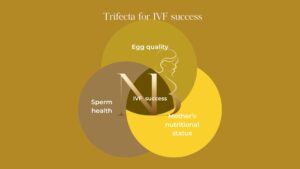 Success after frozen embryo transfer depends on three biological conditions aligning:
- A competent egg
- A competent sperm
- A maternal physiological environment capable of supporting implantation and early development
Egg and sperm created the genetic blueprint carried by the embryo.
By the time you reach frozen embryo transfer, their contribution has already been made.
Embryo grading, lining measurement and progesterone timing confirm one thing: conditions were right for transfer. None of them assess or support the maternal nutritional environment implantation depends on next.
From this point, the third part of the Fertility Trifecta determines whether this pregnancy continues. The embryo must embed, establish circulation, regulate early development and begin forming the placenta within the resources available in the maternal body.
Each process has specific nutritional and metabolic requirements. Yet standard nutritional preparation for FET leaves those requirements to prenatal supplements, generic advice and uncoordinated food choices.
This is the unprepared part of a carefully prepared transfer.
The Mother’s Nutritional Status and Early Differentiation
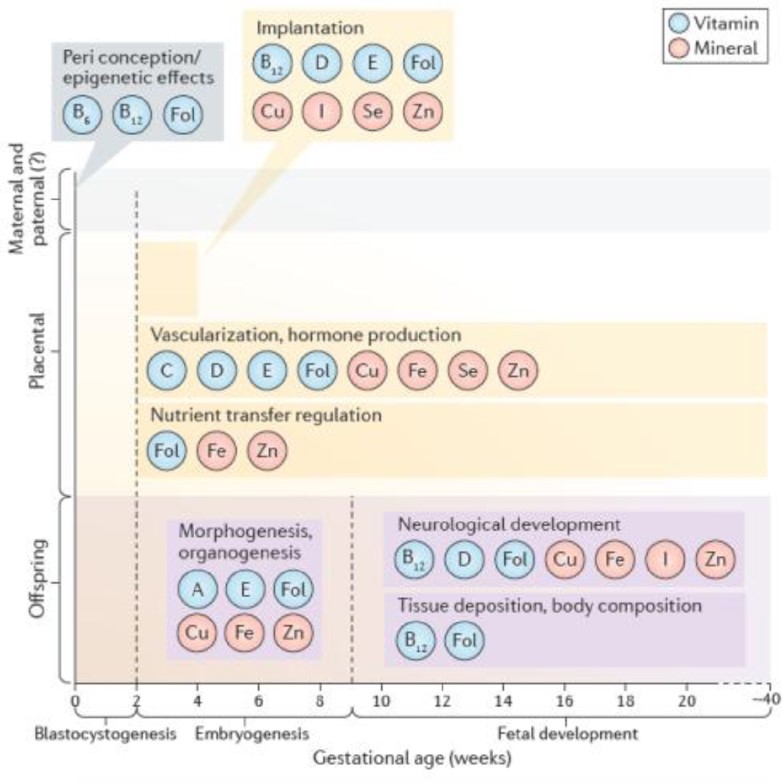
Gernand et al Nat Rev Endocrinol. 2016 May; 12(5): 274–289
Adapted from Gernard et al., Nat Rev Endocrinol (2016), illustrating stage-specific developmental nutrient demands.
By the time an embryo is transferred, early development is already underway.
The biological work of early development has specific, escalating nutritional requirements — not a general baseline that “eating well” covers by default.
Cells are dividing and differentiating into blood cells, bone cells, brain cells and the specialised tissues that will eventually form every organ. At the same time, the embryo must implant, establish a blood supply, regulate immune tolerance and initiate placental formation.
Early development is metabolically demanding. Rapid cell division requires energy. Amino acids are used to build proteins and new tissue, while fatty acids contribute to cell membranes and cellular signalling. Micronutrients enable the biochemical processes through which this development continues.
Before implantation, gene regulation and rapid cellular division are already underway.
At implantation, immune signalling and vascular development become critical.
As placental formation begins, nutrient transfer and blood supply must establish efficiently.
Throughout the first eight weeks, differentiation into blood cells, bone cells and brain cells accelerates.
When these requirements go unmet, stabilisation becomes more difficult, even after the embryo has been created and successfully transferred.
Nutritional Support During the Implantation Window
Your clinic’s preparation was complete for what your clinic can control: embryo selection, lining measurement and progesterone timing. What happens next belongs to your body — five interdependent processes, unfolding over the two weeks between transfer and your beta result.
A prenatal supplement and a reasonably careful diet may feel like enough. Both supply real nutrients. Neither creates the metabolic stability implantation actually depends on.
That stability is what’s missing. Not nutrients arriving separately, but nutrition coordinated to meet that demand as a whole.
The Now Baby FET Implantation Support Meal Plan delivers exactly that: professionally measured nutrition that creates metabolic stability across all five phases, from transfer to your beta result.
Clinical Relevance
After frozen embryo transfer, beta hCG is the first measurable sign that implantation has begun.
Beta hCG is produced by the embryo’s outer cells as it embeds and early placental formation begins. The result shows whether hCG has reached a detectable level at the time of testing — and a rising beta shows that the phases above are actively progressing, not that they are finished.
This is the result you are waiting for. The mechanisms that determine whether pregnancy continues are already active before the first pregnancy test, and they stay active in the days around it.
Implantation After Frozen Embryo Transfer
Embryo transfer places the embryo inside the uterus, but implantation still depends on communication between the embryo and uterine lining.
The embryo must continue developing after transfer. The lining must remain receptive while the embryo’s outer cells begin embedding. Vascular signalling, immune adaptation and early placental formation must then progress around the developing embryo.
A frozen embryo transfer can go exactly as planned and still not result in pregnancy. Transfer places the embryo inside the uterus; it does not complete implantation.
Chemical Pregnancy
A chemical pregnancy after frozen embryo transfer reflects implantation that began but did not stabilise.
The embryo attached. hCG production started and the pregnancy test became positive. But as cellular demand increases, the biological requirements of implantation intensify.
Circulation must establish. Placental signalling must strengthen. Gene regulation and differentiation accelerate.
Embryo development, vascular development, immune adaptation and metabolic support all contribute to this rapid progression. When hCG levels subsequently fall, the pregnancy does not continue.
The result confirms what happened. It does not explain why development stopped.
The underlying processes that determine continuation were active before the loss became visible.
Early Miscarriage After FET
Most early miscarriages occur within the first eight weeks of development, even though they are often identified later at a 10–12 week scan.
By this stage, differentiation into blood cells, bone cells and brain cells is already underway. Placental development is accelerating. Oxygen demand is rising.
If the maternal system cannot sustain vascular development, immune tolerance and nutrient transfer at this pace, progression may stop.
This does not mean every miscarriage is preventable, nor that a single cause explains every loss.
But it does mean that implantation and early development depend on sustained physiological support — not a single moment of attachment.
None of that is fixed. What your body can do with the right support, it can still do.
Targeted Nutrition Through to Your Beta Result
A positive beta result reflects everything that has had to go right inside your body since transfer. This window opens the day after your transfer. Today is the day to have it ready.
The Now Baby FET Implantation Support Meal Plan delivers professionally measured nutrition that creates metabolic stability across all five phases of implantation — the complete 14 days from transfer to your beta result.